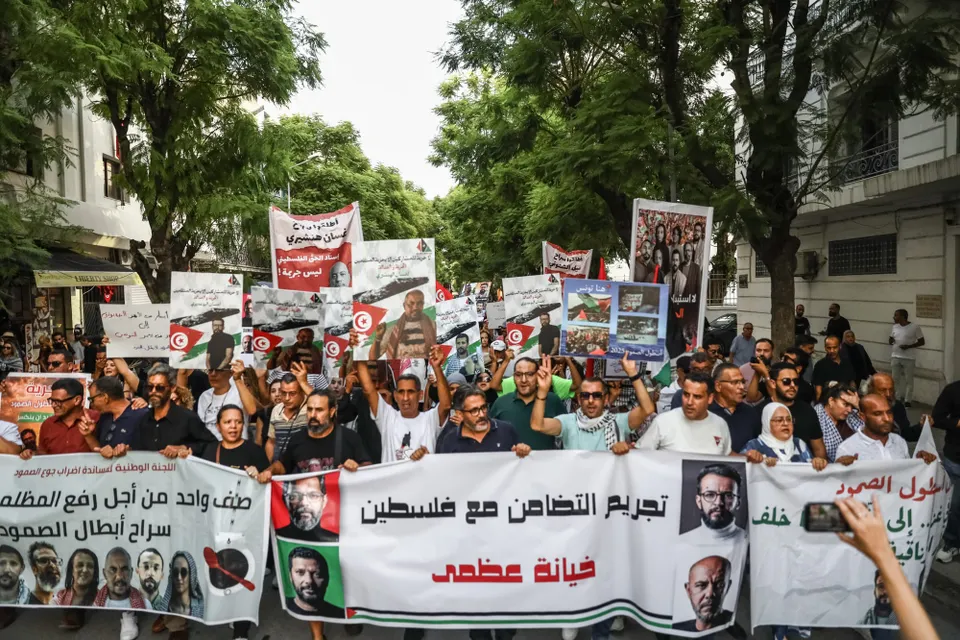
Margaret Owen is 94 years old. When she was finally arrested last week, she had been expecting it for some time. Police officers detained her outside the Labour Party Conference in Liverpool, taking her fingerprints and DNA.
At the time, Owen had been sitting with other protesters holding a homemade placard in support of Palestine Action, the pro-Palestine campaign group that the Labour government proscribed under terrorism legislation last year. After nearly three years of protesting over Gaza, she had long known arrest was a possibility.
“In London I've never been arrested,” the veteran women's rights barrister says. “I think they've never wanted to arrest me because I'm 94 years old and I'm fairly well known in the field of human rights and women's rights in London.” Liverpool was different. “Nobody had a clue,” she says, laughing. “And I was very proud to be arrested and join that club.”
Owen was one of 82 people arrested at the 27 September protest, while another 79 were reported for summons, according to Merseyside Police. She was “never frightened” – not when she sat down with her placard, not when she was arrested and not when she was taken out of the city to a custody suite on the Wirral.
“I knew I was doing the right thing,” she says, “on behalf of all those people suffering such terrible war crimes.” Her voice catches as she talks about the suffering of Palestinians and what she sees as her own government's responsibility for it.
The timing of our conversation matters. It is 7 October, three years after the Hamas-led attacks in Israel that killed around 1,200 people and saw 251 people taken captive, and after three years of devastating war in Gaza. Owen is unequivocal that the horrors of 7 October do not justify what followed. “That doesn't justify what Israel has done in return,” she says. “Absolutely appalling.”
Owen is furious about the use of terrorism powers against people expressing support for Palestine Action, but also about the sheer amount of public money being swallowed by the arrests. She reels off police overtime, forces brought in from outside Liverpool, custody suites and transporting detainees across the region. She says she has written asking for an estimate of the total cost. “I mean, we've come into millions,” she says, before listing areas where that money could be going instead: “Childcare, education, health.”
A ‘tiny chink of light’
For all her anger, Owen does not sound defeated. Despite her arrest outside the conference of the governing party, she believes there may finally be a small opening in Britain's approach to Gaza. Her unlikely source of optimism is Ed Miliband.
“At last we've got a really courageous, good foreign secretary,” Owen says, invoking Robin Cook, who resigned from Tony Blair's government over the invasion of Iraq. She is under no illusion that the shift goes as far as she would like: she points out that Miliband has not described Israel's actions as genocide or committed to stopping all arms.
But his emphasis on international law and human rights has given her something she has not felt much of over the past three years: hope. “Maybe a tiny chink of light,” she says. “But it's a very significant one.”
That hope is not an invitation to stop applying pressure. “We need to build on that little chink of light and use it how we can,” Owen says. She and another campaigner from Defend Our Juries have written to Miliband urging him to lift the ban on Palestine Action and address the thousands of people arrested for supporting it.
But when the conversation turns from arrests in Britain to another group affected by the war in Gaza, Owen becomes even more animated. "I'm so glad you asked that."
For around two decades, widowhood has been an important strand of Owen's women's rights work. She founded Widows for Peace Through Democracy, or WPD, an organisation that, as she cheerfully admits, “practically runs from my kitchen because it never has any money”.
Its concern is not only widows but women Owen calls “half-widows”: those whose husbands have disappeared during war, occupation or political violence, leaving them uncertain whether they are wives or widows. “Are they in a mass grave? Are they in a prison somewhere?” she asks. “They're in an absolute legal limbo. They can't remarry. They have no rights.”
The women holding society together
Owen says there are at least 28,000 widows in Gaza since the war began, and believes the true number is likely to be much higher given the number of missing people.
Yet what concerns her is not simply the number of women who have lost husbands. It is what happens next. “These widows are the ones that keep whatever the remnants of society – keep it together,” she says, describing women caring for orphaned children, elderly relatives and the wounded while coping with their own grief, displacement and insecurity. “They're the salt of the earth.”
But she does not want praise for women's resilience to become another way of rendering them invisible. When decisions are eventually made about Gaza's future, Owen argues, the women who have survived the war should be part of making them.
“Whenever there are any peace deals, it's they, these widows, who need to be at the tables with their testimonies,” she says. “Their voices need to be heard.”
And yet she is just as quick to talk about resistance. “They're so resilient,” she says, enthusiastically naming women she works with around the world.
At 94, Owen moves conversation easily from a police custody suite on the Wirral to Gaza, Kashmir, Congo and Kenya, and back to a chat she had in her own living room decades ago. The thread connecting them is her insistence that people whom governments and institutions overlook should be seen and heard – whether protesters holding homemade placards or women left holding families and communities together after war.
And despite everything she describes, she ends somewhere surprisingly close to optimism. “I hope,” she says, “that the UK now is on the up.” After three years, she thinks she can finally see the light at the end of the tunnel. But that is not a reason to stop protesting, Owen insists; it is a reason to push harder.