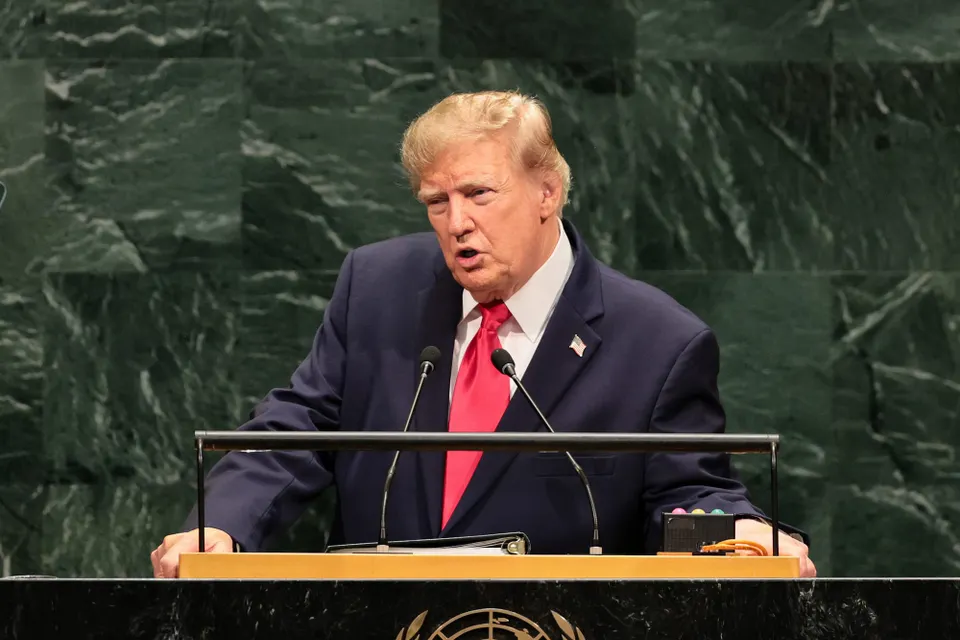
In a speech on 1 July, President Bush acknowledged that US forces would remain in Iraq as a massive and long-term undertaking, facing up to the terrorists, extremists and Saddam loyalists who have been killing and injuring US forces.
He also implied that the situation was under control. This view is echoed by the head of administration in Iraq, Paul Bremer. Those few remaining individuals who have refused to fit into the new Iraq are becoming more and more desperate, Bremer said, also on 1 July. They are alienating the rest of the population.
This upbeat assessment contrasts with casualty figures recently released. According to the Washington Post, since the war started on 20 March, 195 US military personnel have died in accidents or combat, but nearly one third of those deaths have happened since President Bush declared the war to be over on 1 May.
Putting to one side the casualties suffered in accidents, in the nine weeks since he made his speech on the aircraft carrier USS Abraham Lincoln, 31 US and British military personnel have been killed and 178 wounded. The number of deaths may seem high, but it is the second figure, of close to 200 wounded, that is actually the more significant.
In modern warfare, a crude medical calculus is that three people are wounded for every person who dies. In Iraq, currently, the ratio for allied soldiers is six to one. The reason for this is almost certainly that US troops exposed to attacks are commonly patrolling in armoured vehicles and are wearing body armour that provides effective protection against life-threatening injuries from light arms and grenade fragments. As a result, many soldiers have their lives saved but are suffering serious injuries, especially limb injuries.
The reason this is significant is that it lends credence to reports of large numbers of attacks on US units in central Iraq, with as many as a dozen attacks on patrols every day. It is stretching credibility to lay this at the door of the desperate few remaining individuals who have refused to fit into the new Iraq. Rather, it suggests the US and Britain could be getting involved in a very difficult situation that may grow into a full-scale anti-occupation insurgency.
The easy answer is that time will tell, and that we will get a reasonably accurate idea within six months. At the same time, there are several pointers that already give us a sense of the possible direction of events.
Military control and Iraqi anger
The first aspect to remember is that Iraq is under a fully-fledged military occupation run from the Pentagon, not the State Department. The ultimate authority in Iraq is General David McKiernan, with Paul Bremmer heading the Pentagons Office of Reconstruction and Humanitarian Assistance (ORHA) reporting to Defence Secretary Donald Rumsfeld.
Progress at democratisation has been remarkably slow, with very limited Iraqi influence allowed from former exiles or in-country sources. The calling of congresses at national or local levels has been consistently delayed and local administrators, where present, are appointed by the occupying forces.
Baghdad was initially placed under the control of Barbara Bodine, a State Department official, but she was transferred away from the post within a month and, as of 29 June, has not been replaced. Roger Buck Walters, a Texas businessman and former US Army officer, administers Southern Iraq. W. Bruce Moore, a career US Army officer with service in Vietnam and Somalia, administers Northern Iraq.
The second factor is the impact of the Iraqi war casualties on attitudes to the liberators/occupiers. Civilian casualties were somewhere between 5,500 and 7,000 killed (www.iraqbodycount.com), with military casualties certainly exceeding 10,000 and possibly much higher. Overall, as many as 20,000 Iraqis were killed in three weeks of fighting, and around 50,000 were probably injured.
Although there were significant civilian casualties in the fighting around Basra, Najaf and other southern cities, the main concentration of deaths and injuries was in and around Baghdad. The Republican Guard divisions south of Baghdad sustained most of the military casualties. Much of the ordinary Iraqi army was not heavily engaged in the fighting and melted away or was subsequently disbanded by the US occupying power.
Thus, the great majority of the casualties would have been drawn from the Sunni areas of central Iraq, and most of those 70,000 killed or injured would have had a network of family and friends running to millions of people. The great majority of the Sunni population of Iraq would probably have known someone killed or injured in this war. It is an aspect that appears to be entirely ignored by most analysts but may come to be seen as underlying much of the opposition now in evidence.
Related to this is the third factor that the Sunni communities of Central Iraq were the main beneficiaries of the old regime. Throughout the twelve years of sanctions, Iraq had a system akin to the old Soviet nomenklatura an elite of a million or so, drawn from the security and intelligence forces and apparatchiks and their extended families. They survived the sanctions period more or less intact, often at the expense of the majority population of Iraq, and comprise the main focus of opposition to occupation.
A Shia insurgency
Even so, are these not just irrelevant if troublesome remnants as we are repeatedly told? The answer is probably no, and the reason relates to the closing stages of the original three-week war. For whatever reason, whether by the Americans buying off the leadership, or by design, the elite Special Republican Guard and the tens of thousands of people attached to the various security and intelligence organisations all failed to offer serious resistance to the US entry into Baghdad, Fallujah and Tikrit.
Almost all of these forces, numbering at least 40,000, melted away with their arms and ammunition largely preserved. Furthermore, in the aftermath of the original war, there was widespread looting of ordinary army munitions stores and the disbanding of that army of nearly 400,000 troops, most of them released to join the ranks of the unemployed.
Looked at this way, a picture emerges of remnants that could number in the many thousands, mostly trained in irregular warfare, well-armed and supported by a public mood that, in many parts of Iraq, has become increasingly anti-American.
There are two further factors to add. One is that the US forces, under severe pressure and with internal problems of morale, are increasingly jittery as the attacks intensify. They are reacting with considerable force, including vigorous house-to-house searches and mass detentions, and these actions are only serving to increase hostility to their presence, as well as support for those attacking them.
The final factor is that the entire effort at reconstruction, including plans to redevelop the Iraqi economy along free market lines, is proving deeply problematic. Even twelve weeks after the end of the war, there are persistent and major problems of electricity and drinking water supply, sewage treatment and even food distribution, with long-term delays in oil exporting now anticipated. On top of this, there is rampant unemployment, not least including the hundreds of thousands of young men dispersed from the disbanded army.
Part of the problem lies with the destruction of a rigid and authoritarian regime that was actually well-organised in terms of the running of infrastructure, even under sanctions. But the very sanctions experience meant that much of the infrastructure was crumbling, making reconstruction in the current administrative vacuum particularly difficult. It is a situation being exacerbated by sabotage in a country where key parts of the economy such as oil pipelines, lend themselves to disruption.
Beyond this, though, is a problem which might best be described as cultural the Bush administration is simply not into peace-building. This is actually in some contrast to attitudes in the European Union, including Britain, and has been demonstrated powerfully in Afghanistan, where the US has consistently blocked the expansion of the International Security Assistance Force.
As already stated, Iraq is under military occupation in a process run by the Pentagon and under the direct control of Rumsfeld, Wolfowitz and their associates. This neo-conservative group operates principally on the basis of forceful control of security threats, a mindset that is being applied in Iraq with the current consequences.
On the basis of all of these factors, a conclusion can be drawn that, on present trends, and leaving aside the further problem of Shiite political developments, opposition to US occupation is likely to grow, with an increasing emphasis on insurgency and guerrilla warfare.
Where next
One question remains. Is all of this down to the Saddam Hussein leadership? If the opposition is centrally planned and co-ordinated, then will the capture or killing of Saddam Hussein and his sons bring this opposition to an end and make the tasks for the United States easier? There is no easy answer to this question, and it may well lie at the heart of current US military efforts to find this core group.
Even so, there is evidence of a resurgence of a form of Iraqi nationalism in opposition to occupation, and this is coupled with support for this opposition that includes radical elements from the wider region. In the short term, the capture or deaths of the core leadership might have little effect on the current violence, but it may make a difference.
The key point is that even if it does, this could be short-lived. It is blindingly obvious that Washington does not envisage allowing a truly independent and democratic Iraq to emerge. After all, one of the first requirements of such a government would be for the US forces to leave forthwith.
If the current violence dies down, it may take a year or more for this realisation to have its full impact within Iraq, leading to a resurgence of a more deep-seated and pervasive opposition. On present trends, though, we may not even experience a temporary easing of violence.
An earlier article in this series, one week into the war, sounded a pessimistic note, suggesting a war that might last many months. With the war ending just two weeks later, it was an analysis that hardly seemed to stand the test of time. On reflection, though, it may have been wrong in detail but right in substance, and what we are now seeing is the development of a substantial, dangerous and long-term confrontation with fundamental implications for US security policy in the Persian Gulf.