Discussions with foreign leaders about the future of Iraq held this week in Washington and at the United Nations failed to deliver an outcome in line with the requirements of the US administration. As this weeks speeches at the UN General Assembly showed, the differences between the parties are considerable, and the end result will most likely be one that has very little effect on what is happening on the ground in Iraq.
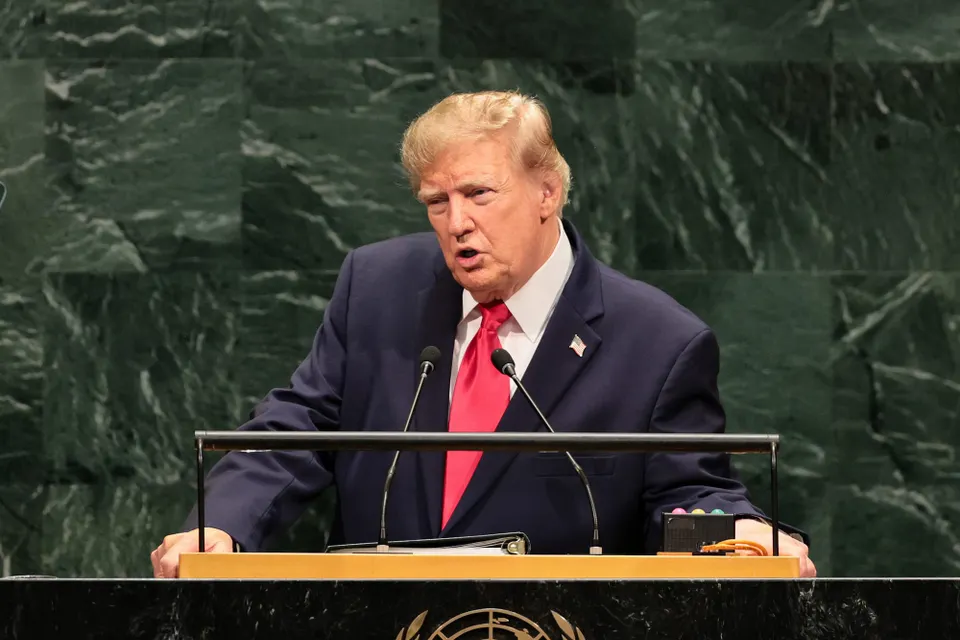
President Bushs speech this week made few concessions, but what was significant was the combination of the reception given to his speech by the assembled diplomats and politicians, and the blunt warning from Kofi Annan earlier in the day. It is probably unprecedented for a speech from a US President to the General Assembly to be received with so little enthusiasm, and it is significant that Annan felt able to make a notable if implied criticism of unilateral actions such as that against Iraq last March.
Although Bushs position seems robust and unyielding, the reality is that the position of his administration is being determined by a remarkable array of unexpected and unwelcome factors in striking contrast with what had been anticipated as the likely situation once the Saddam Hussein regime had been terminated. This contrast between the theory and the reality is worth recalling in trying to make sense of the extent of the US predicament, and the concerns that it is raising in Washington.
The theory
When the war was fought and the regime destroyed within the space of just three weeks, there was a firm expectation in Washington that effective control of Iraq would be forthcoming, leading in due course to an acceptable client regime in charge of an oil-rich state opened up for international business, no doubt to the particular advantage of US companies.
In the short term Iraq would be managed from the Pentagon, which would also be in a position to develop permanent military bases in the country while rapidly scaling down the number of combat troops. According to the New York Times, four bases would be established, focused on air bases or airports originally developed by the Saddam Hussein regime.
One would be close to Baghdad, almost certainly at the international airport, but the other three would be carefully chosen for wider strategic reasons. The Talill air base near Naseriyeh conveniently near to the huge oilfields of southeast Iraq, would become a second, and another would be centred on the airfield at Bashur in northern Iraq, close to the Kirkuk/Mosul oilfields. The final base was expected to be at the H-1 airfield, a sprawling complex close to the Syrian border, although there might also be a small naval facility at Umm Qasr on the Gulf coast. Apart from Baghdad, the bases would not be large in terms of permanent military personnel, but each would have a continuing military presence together with facilities for rapid reinforcement.
Their location would serve three long-term purposes ensuring the security of the two main clusters of oil fields in Iraq, maintaining a base close to Syria, one of the lesser members of the axis of evil, and putting real pressure on Iran, a leading member of that axis.
The situation for Iran would be particularly satisfactory from Washingtons point of view. Military bases in Central Asian republics such as Uzbekistan would increase influence over the eastern part of the Caspian Basin oil-bearing region, helping to diminish any Iranian involvement. Furthermore, permanent military bases in Afghanistan, at both Bagram and Kandahar, would mean that Iran had a US presence in Afghanistan to the east as well as in Iraq to the west, and would also have to contend with the presence of the US Fifth Fleet in the Persian Gulf and the Indian Ocean.
The political result of all of this would be the long-term control of Iraq together with the ability to put maximum pressure on Iran. More generally, success in Iraq would be a powerful warning to states such as North Korea, Syria and Libya that any attempt either to develop weapons of mass destruction or be seen to foster terrorism would meet a response from a determined, effective and overwhelmingly powerful United States.
In Iraq itself, the intention had been to reduce US forces to no more than 60-70,000 troops. Moreover, a substantial proportion of those would be engineering, logistics and support troops, largely concerned with developing the permanent presence. There would be little need for occupation troops because there would be little opposition to the US presence. The significance of this was that the US Army, in particular, would be able to withdraw at least two divisions, a really valuable outcome given the overstretch that the army was beginning to experience.
The reality
Contrast this with the actual position, and the wider components of the American predicament. Six months after the war, the United States has close to 140,000 troops in Iraq, with a large proportion of them engaged in a violent and costly urban guerrilla war that is causing substantial casualties, is leading to escalating military costs of occupation (see last weeks column) and shows no sign of diminishing.
Further deaths and injuries in the past week and the second attack on the UN compound have been accompanied by larger numbers of deaths and injuries to Iraqis, adding to the endemic criminality affecting much of central Iraq. Experienced journalists in Iraq are reporting that the security situation within the country is continuing to deteriorate, and this is before there is any real effect from paramilitary groups from elsewhere in the region establishing themselves there.
In the United States, opposition politicians are now confident enough to make comparisons between the $87 billion that President Bush is seeking for Iraq with lack of domestic spending on issues such as health care, urban security and even power supplies. Opinion polls are registering a significant drop in support for Bush, with much of it due to the ongoing war and its costs.
In Iraq itself, members of Iraqs appointed Governing Council are starting to demonstrate independence, including a planned visit to the US Congress to argue for a more speedy political transformation. This coincides with French insistence on similar moves, with little likelihood of substantial international help for the United States in the absence of major concessions from Washington.
The French position may stem partly from French perceptions of their historic role in the Middle East and the Arab World as well as the long-term suspicion of the United States, but there is a profoundly cynical aspect to this, given that France, together with Russia, was the key military supplier to the Saddam Hussein regime prior to 1991 when it committed its greatest atrocities.
Where next?
Some aspects of the original US plan are still being carried out. Bases are being established in Iraq and Afghanistan, and the Iraqi economy is going to be opened up to privatisation with particular inducements for favoured international businesses. But this cannot disguise the much more general problems now being faced.
Given that the French do want to gain more influence in the region, there may well be a softening of the differences in the next few days and weeks, but there are three issues that add to the weakness of the US position. One is that almost all of those countries capable of committing either significant military forces or substantial aid to Iraq are deeply reluctant to do so. It will be politically undesirable to put their young soldiers at risk in a burgeoning guerrilla war, and few countries intend to bail out the US of its financial commitments.
The second issue is that the bitterness towards the United States that is felt by United Nations professionals remains, stemming partly from the loss of UN personnel in Baghdad but with this serving to sharpen memories of the near-contempt with which the UN was treated by the Bush administration in the run-up to the war.
Finally, the bottom line remains, as ever, that the United States simply must maintain control of Iraq, and to hand over the transition to independence to a multinational body such as the UN will be unacceptable to the administration.
The consequence of all of this is that whatever happens in terms of UN resolutions, and whatever appears to be a compromise, the reality will be that the United States remains very much on its own, and will have little option but to continue fighting a dangerous and messy war.
Moreover, this is a war in which external paramilitary forces have scarcely had any effect. If, as is probable, that is still to come, and may develop over the next six to twelve months, then we should not be too surprised if, apparently against the odds, there is a real change in US policy in the early months of next year. Such a change might well result in many US troops being brought home during next years election campaign, but it would also signal a fundamental shift in US Middle East policy that would contrast markedly with those confident expectations of just a few months ago.