The two most recent articles in this series have concentrated on Iraq and it might therefore seem that yet another piece of analysis is not necessary. It is true that the issue of weapons of mass destruction (WMD) continues to have its effect in British domestic politics and is even relevant in the United States, but otherwise there seems little to indicate that the US predicament in Iraq is changing from week to week.
In practice, though, there were four important developments towards the end of September that collectively help us to assess the likely trends in the coming months. The first concerns events at the United Nations; the second relates to US domestic politics; the third and fourth and perhaps the most significant are about the resistance in Iraq itself and the costs of reconstruction.
No respite at the UN
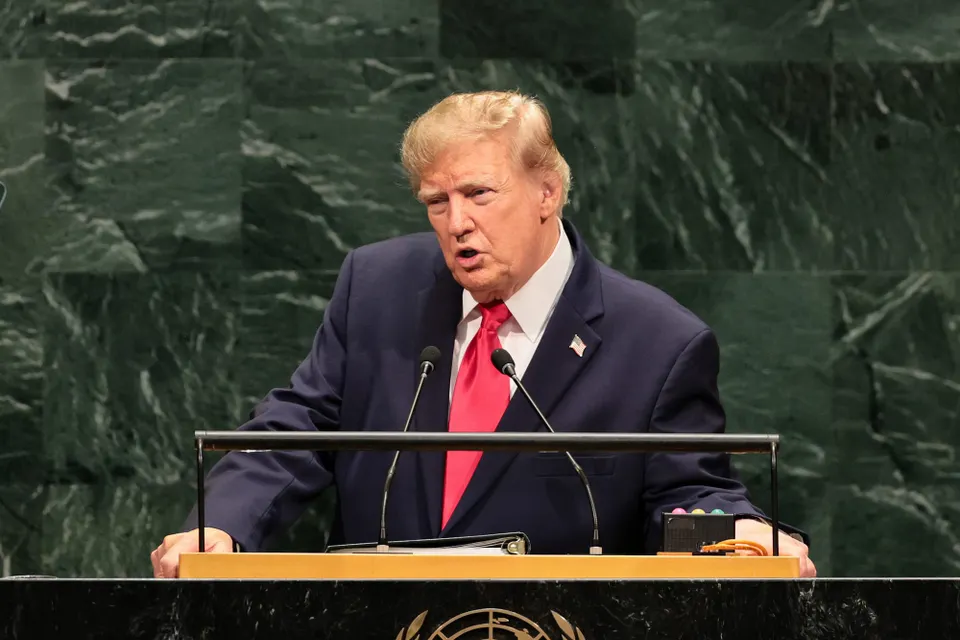
The first development surrounds the UN. After a substantial period of back-room diplomacy, culminating in President Bushs extended presence in New York, it is apparent that other states are simply not prepared to share the US burden in Iraq to any significant material or logistical level. It will be possible to point to small contributions from quite a number of states, but what the Americans need and want is a commitment running to very substantial numbers of troops.
In short, the US really needs individual deployments at the strength of a full army division up to 18,000 troops which can be largely self-supporting and take responsibility for a major part of Iraqs territory, thus releasing US troops for counter-insurgency and public order control in the central region. There is no sign of any such troop commitments, nor is there any indication of significant support for civil reconstruction. The United States is thus effectively on its own.
One expression of this reality is that the US army has now had to call up around 15,000 reservists for extended service, a move that though essential in military terms will prove unpopular. Yet another indication of the armys predicament is that it has started a process of airlifting soldiers back to the United States for just fourteen days leave, as part of an effort to try and boost failing morale in Iraq. The introduction of fourteen-day round-trips of up to 25,000 kilometres each gives some indication of the problems the US army is facing.
The domestic American context
The second important recent development reflects the domestic balance within American politics. During many meetings in and around the UN building in late September, many UN diplomats were anticipating a degree of conciliation from the White House, and were frankly surprised at its still relatively hardline attitude. It became clear that Washington was simply not prepared to share power, yet still expected support for its operations (see Peter Slevin, Reluctance to Share Control in Iraq leaves U.S. on Its Own i>Washington Post, 28 September 2003).
This attitude of the Bush administration to the United Nations even in the face of its Iraqi problems is indicative of its underlying outlook. The neo-conservative agenda, with its antipathy to the UN, is still holding sway. Many people in the state department and in the uniformed military can see that the US has huge problems ahead in Iraq; this perception is simply not shared by the neo-conservatives.
Meanwhile, the two houses of congress are considering President Bushs war-spending request of $87 billion; early indications are that Democratic politicians may actually seek to increase it in certain areas. Given the large numbers of US troops in Iraq, it is politically dangerous for Democrats to be talking about cutting back funds for the armed forces. Examples of possible further requests include proposals for more armoured vehicles, an additional 10,000 troops for the army, and extending health insurance to reservists and their families. None of this is cheap, with these three items alone capable of adding $1.2 billion to the bill. (see Jonathan Weisman Congress Likely to Add to War Request, Washington Post, 30 September 2003).
Much of this reflects a political calculation from within the Democratic camp that they can have it both ways gaining popularity by supporting the troops in Iraq yet also seeing the Bush administration bearing the political impact of the occupations escalating costs.
Furthermore, some Republican politicians are determined to avoid American taxpayers footing the bill for Iraqi reconstruction and want any money provided to be in the form of loans, repayable from Iraqi oil revenues. The cost of reconstruction was confidently expected to come from such revenues, but a combination of a badly degraded Iraqi oil industry and sabotage means that oil exports remain minimal.
Attrition in Iraq
The third important recent development relates to the situation in Iraq itself. There, the extent, capabilities and tactics of the resistance forces, and the size of the reconstruction efforts required across much of the country, are both posing severe questions to the Americans.
The latest guerrilla opposition to US forces has three outstanding aspects. First, the degree to which paramilitary forces are attacking appointed Iraqi leaders; last week Akila Hashimi, a member of the Governing Council, died from wounds following an assassination attempt, and an attempt was made to kill Jalaladin al-Sagher, a key appointee in the drawing up of a new constitution. There was also a further attack on the UN compound that has led the organisation finally to evacuate all but a skeleton staff of its international specialists.
The second aspect is raised by the 27 September attack on the al-Rashid hotel in Baghdad which houses US military and civilian staff. Although only superficial damage was done by the three mortar rounds fired from a neighbouring, densely-populated district, it showed that paramilitaries are capable of attacking a core part of the US leadership in Iraq. The fourteen-storey hotel is close to one of Saddam Husseins former palaces where the US occupation authority is based, and lies within a high-security cordon that protects this and other buildings.
The attack took place early in the morning and those responsible were able to escape through the crowded Salhiya neighbourhood. The very possibility of carrying out such a raid illustrates the extent of the problem facing the US forces as they contend with urban guerrilla warfare that is very difficult to counter without causing substantial civilian casualties.
But it should not be assumed that the main problem for the US forces is of small hit-and-run attacks in the towns and cities. Indeed, the third aspect of the developing war is demonstrated by the large-scale attack and the forceful US response around Habaniya, 60 kilometres west of Baghdad, on 29 September .
This incident began with a bomb attack on a US convoy, which killed one American and injured three others. The convoy was then ambushed by guerrilla forces using small-arms and rocket-propelled grenades, leading to a three-hour battle with the US troops using tanks and attack helicopters against the guerrilla forces. Eventually, some Iraqi fighters were isolated in a building but two helicopters called in to assist the US troops were then themselves attacked by another twenty or so Iraqis from another building.
In all, the fighting lasted for eight hours, with fourteen Iraqis detained and an unknown number dead.
There is little indication, even with this scale of attacks, of opposition to US forces coming from outside elements. That, almost certainly, is still to come. At present, the key question is whether the Iraqi population turns against the US occupation to the extent that guerrilla forces might even make the country uncontrollable.
The evidence here is mixed. Some preliminary opinion surveys suggest quite strong opposition to the guerrilla groups, but there are other indications of gathering support. Perhaps the most important element here is how the question of resistance relates to the problems of reconstruction.
The price of reconstruction
These problems are, bluntly, formidable. (see Rajiv Chandrasekaran, Crossed Wires Deprived Iraqis of Electric Power, Washington Post, 25 September 2003). It is now becoming clear that much of the Iraqi civil infrastructure was almost on the point of collapse before the war began in March 2003 and that it will cost much more than the $20 billion being sought by the Bush administration to put it right.
Twelve years of sanctions were made much worse by a repressive regime that maintained the support of its elite forces by largely ignoring the needs of the great majority of Iraqis while blaming the United States for the many problems of the country. Now, efforts at reconstruction are woefully inadequate and inefficient, and are made worse by persistent sabotage, smuggling and a rampant black economy.
The import of this lies in the contrast with more distant times. As the Baath party developed and consolidated its power base in the 1970s, it invested heavily in the military but also accelerated civil modernisation. Buoyed up by the high oil prices of that era, Iraq developed a modern education system and health service and there was heavy investment in public works projects.
However repressive and brutal the regime, Iraq was way ahead of most of the third world, and largely survived in that mode despite the costs of the eight-year Iran-Iraq war. For many ordinary educated Iraqis, the 1990s was a nightmare decade culminating in the recent war, but at least leading to the expectation of a return to a standard of living that could still be remembered from twenty years previously.
It is here that the current parlous state of public order and public services is so significant. Any confident expectation that US liberation would usher in a period of rapid redevelopment has already dissolved, to be replaced by occupation, insecurity and economic hardship.
This is a thoroughly dangerous circumstance for the United States, and the development of a widespread antagonism that could be fuelled by a pervasive nationalism is only a short step away. Put bluntly, the US may only have a very few months to demonstrate a more viable future for the ordinary people of Iraq.
If its effort in this direction fails, then the consequences might include an evolving insurgency deriving both from internal Iraqi opposition and by foreign paramilitaries which gathers support from significant sectors of Iraqi society. From the US military perspective, that could well be an unwinnable war.