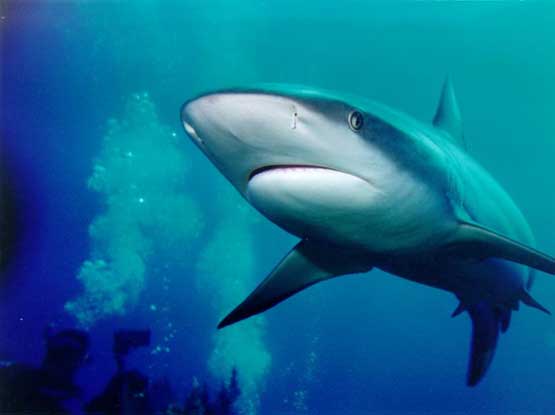
When I was 10 years old I read a book of careers and stopped at the letter O. Oceanographer. I was already passionate about sharks and the sea, and what the book outlined was the career of my dreams. I decided then that my lifes course would be upon the ocean.
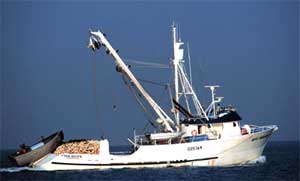
Tuna boat with purse seine searching for tuna
courtesy Dann Blackwood/U.S. Geological Survey
Since then, Ive spent time on a number of different kinds of vessels: small wooden purse seine vessels (18 metres long), small wood or fibreglass longline vessels (2030m), larger steel stern trawlers (5075m) and large steel midwater stern trawlers (120m).
My oceanography training, from 2001, involved two semesters of practical or inservice work. Thats when my adventures began.
The main part of my work involves taking samples of the fish that come aboard the vessel. I identify, measure, sex and weigh the fish. All the data gets recorded and later analysed ashore. The report written after each voyage goes to the relevant sea fisheries department which conducts length and weight regression lines to help determine the stock strength of the fish; this in turn helps it define the next years fishing quotas.
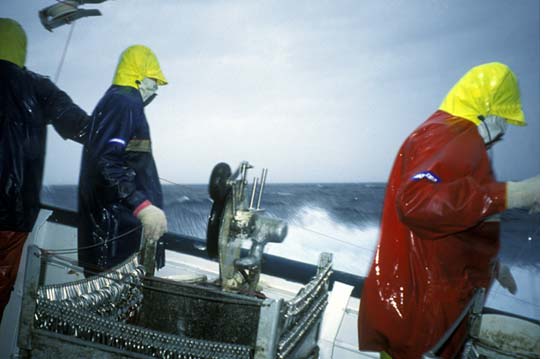
In December 2002, I worked as whats called an observer on a Russian midwater trawler. Like all vessels, it was a small community, with its own rules and social politics. As so often, only a few crewmates could speak English, so theres the language barrier to consider. But there were other women on this boat, very friendly, and each of us had a group of men to look after us.
Thats always how it goes on a Russian vessel. If someone is nasty, or says something bad to the woman theyve chosen to protect, that person soon finds himself confronted by these knights of honour. Its rather like having your own guardian angel. Ive always been lucky in finding myself on female friendly vessels. Its incredibly important, as Im usually the only woman aboard. As Im quite small too, I usually end up being treated somewhat like a doll.
I was on board for a month that first time. Its hard work. An observer has to operate on a 24hour schedule, so you have to prioritise work, sleep, eating, social time. Works the most important, but sleep is fast to follow. Observers are usually berthed right beside the winches, deliberately I guess, as you cant sleep through the noise and need to be awake anyway whenever the winches start to roll.
A voyage like that tests your commitment, shows up your strengths and weaknesses. But its incredibly satisfying, and makes me very happy. Even happier, in fact, after I actually fell in love with a Russian fishing master. This is something strictly forbidden for obvious reasons, so it wasnt until we were back on land that things could progress, and I went to meet his family in St Petersburg. Now were engaged. Interestingly, the women on the vessel were disappointed that I had chosen a man of lower rank than myself something theyd never have done.
Your relationship to the land changes completely when you start to spend time at sea. Simple things, like whether or not your family is happy with you spending 80% of your time away from them, and that youre liable to be called away at a moments notice. My nowfiancé spends eight months at sea, eight on land. But he has no control over where I am or what I do when hes at sea, or viceversa. Oddly, this kind of life has no stress, because theres nothing whatsoever you can do about things on land while youre at sea. You have to let it all go. It is a great escape on every level.
The income fluctuates a good deal, too. You have to be able to handle that. There are always stories flying around: one guy I know came back from a fivemonth trip with enough money to buy a house the next week, for cash. Another came back from a long stint at sea, tried to enter his parents house and the burglar alarm went off, the police arrived, great uproar, until he discovered that theyd actually moved house while he was away, hed lost touch so entirely with what was happening on land.
Once, a twomonth trip became so exhausting that I started to wish we would hit a patch where there were no fish. That time, I spent Christmas, new year and my birthday on board. I remember when we docked I felt nauseous for days afterwards: the opposite of seasick, I was landsick. After a long trip you miss the movement of the sea.
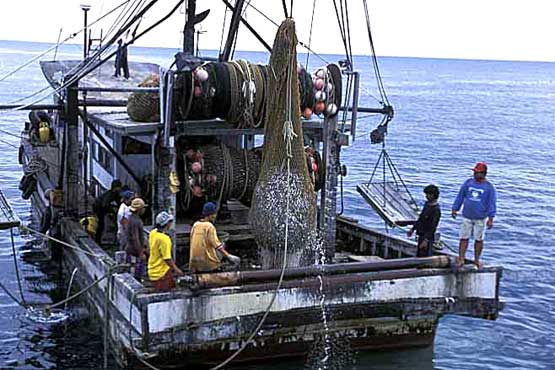
You have to think like a fish
Longline fishing, first used by the Vikings, is perhaps the most interesting to me. The technique is as its name suggests: a very long line with hooks set on it every few metres. The hooks are baited; your target species will determine the depth at which the line is set. A line with hooks spaced a little distance apart but not very close to the bottom is mostly for tuna species and swordfish. When the hooks are closer together and the line is set as close to the bottom as possible, it is most likely for hake.
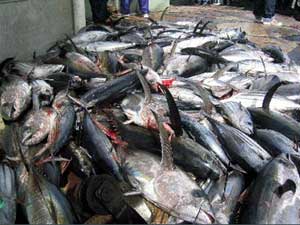
Yellowfin tuna courtesy Craig Knickle
The obvious problem with longline fishing, as with trawling, is the issue of bycatch in other words, what is caught unintentionally, and not the target species. Trawling seems to be more friendly but once you look at it closely you find that the pros and cons in both methods are about equal. Despite attempts to make longline fishing more ecofriendly, the amount of bycatch always astonishes me.
A subset of bycatch is byproduct, where the actual haul has a higher value then that of the target species for example, monkfish caught in hake fisheries; whereas regular bycatch has a lower value than the target species. It has no market value and is usually wasted, eaten as fries by the crew, or just taken home and cooked for example, jacopever.
Before, I always thought that you just dropped the bait in the water and the fish would come to take a bite. But theres much more to it than that. Fish are actually quite complex. They swim around, look at the bait from every angle. They notice the other bait, inspect the whole line they dont just want an easy meal, they want the biggest and tastiest that the line has to offer. Sometimes this choice means therell be a fight or standoff with another tuna, or other predatory fish.
But once the line is in the water, all the fisherman can do is wait. Most of the time they just sleep, as the line is shot at night. When it comes to pulling in the line, there are always tangles, and the fisherman is lucky if theres something on every other hook. Its hard work.
When the tuna start coming into view, the job of the gaffer starts to bring the fish aboard. The gaff is a long pole with a curved hook, used to hook the fish in the eye or behind the operculum (the cover on the gills of a fish). Its not an easy job. Some of the fish are very heavy and sometimes theyre still alive. Ive seen gaffers nearly pulled overboard because a fish is putting up such a fight. Ive also seen the injuries inflicted on the gaffer by a struggling fish. Its not a pleasant job but it is exhilarating and rewarding.
Hooks are normally baited with squid. When fishing for tuna, the squid is dyed a pretty colour. Each fisherman has his or her own theory about which colour works best. The most recent vessel I worked on used pink and green dye. They alternated the colour, giving the tuna a variety to choose from. The bait smells strong. You have to think like a fish. If you were a hungry tuna just swimming around hoping for an easy meal, would you be tempted to take a closer look, maybe a nibble?
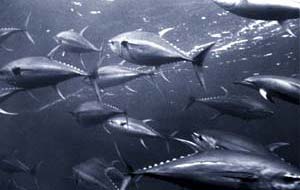
Schooling yellowfin tuna courtesy National Oceanic and Atmospheric Administration
The main thing to remember about longline fishing is that its passive, and involves a good deal of waiting and patience. The line is cast and the fisherman hopes for the best. Yes, the line may be cast in grounds known to be good for tuna, where the water temperature is perfect, but that doesnt mean that the tuna are nearby. Fishing is not an exact business. You have to have a lot of experience and a lot of faith.
Once the fish is aboard the vessel it is bled through small incisions made in strategic points in the body. A wedge of flesh is also removed from what you can think of as the forehead of the fish, a tube inserted, then a thread stuck into a little channel of bone which holds the central nerves of the fish so theyre severed, to stop the fish from thrashing about on the vessel.
By doing this, the fisherman decreases bloodflow to the muscle tissue of the fish an important thing in financial terms, because as the blood is very acidic a normal bloodflow would cause the meat to break down much faster and create a buildup of toxins in the tissue. The fish would then not fetch a good price when it is brought to land. Fishing is all about money; and good quality ensures good money.
The fish is then gutted and cleaned but kept whole, and put into a kind of sock plastic, or cheesecloth and lowered by a pulley system into the hold to be stored in ice.
The oceans collateral damage
Its always sad though in my experience not too frequent when birds are caught up in the line as bycatch. Beautiful birds like cape gannets and sooty petrels, who are not diving after the catch itself a tuna would probably eat a bird like that but after the bait. Its inevitable I guess, but still quite upsetting to see a bird come up on the line.
More dramatic than birds, and quite common when were going after tuna, is when larger fish are part of the bycatch. Seeing a swordfish up close is heartstopping, theyre so much larger than you imagine. The sight of a great marlin on the line a fish built for speed and power takes the breath away even from the crew.
For the crew, these incidents are a blessing and a curse. They bring value to the catch and are like a nugget of gold to a miner, but they make huge tangles in the line, or sometimes break it when theyre struggling to free themselves. But they fetch a high price at the fish market. If there wasnt such a great demand for these fish from restaurants and the public, the price would go down and the fishermen wouldnt be so interested in catching them.
Sharks a fish very dear to my heart also get caught like this, and have a similarly high market value. This is odd: the major ingredient in sharkfin soup is water, jazzed up with chicken stock, because the fin itself actually has no taste. Yet at $200 dollars for a bowl of sharkfin soup, these creatures will never be safe.
Most shark caught when I was on the tuna longliner were either blue or mako shark. Evolution has done an incredible job with sharks, and these ones in particular are built for what they do. The blue cruises deep water, is very pretty with a beautiful colour, has long clean lines and a very elegant shape. The mako is torpedoshaped, for speed, with fraillooking teeth and a stare that will pin you to the spot. Neither of them give up, even when they are on deck. Theyll try to take a bite from whoever threatens them, even though they know that they have lost the ultimate fight.
Ive seen a pregnant blue shark brought on deck. She was beautiful like only pregnant animals can be: shed retained her shape and clean lines but was large and heavy in the middle. She put up an incredible fight in the water and must have realised what was happening, and that she wouldnt be free to roam the ocean after this fight, because she started to abort her load.
She dropped about four pups in the water, and continued to drop more when she was on deck. Still she kept up the fight, thrashing and lunging at everything and anything that moved. A crewmember got on top of her as a bullrider gets on a bull. He straddled her head and was still thumped on the back by her tail. He had his thighs by her gill slits and clamped them together, shutting her air intake. He cut her dorsal fin off, then her pectoral fins, then started to cut off her head.
I had to walk away, hide my tears. But then I saw all the pups that she had been aborting. If she couldnt save both her life and theirs, she tried to save theirs. Its a common perception that sharks have no maternal instinct, and that expelling the pups from her body like that was just something that all animals do: they lighten their load so that they can flee. But to me she showed courage and Ill never forget it. It was extraordinary.
I asked the captain if we could release the pups into the water where they might stand at least a chance of survival. I think he saw the tears on my face and the desperate look in my eye, because he agreed. I counted a total of twelve pups that shed been carrying. They were all perfectly formed, even with sharp little teeth. They are born to hunt, with the same beauty of a fullgrown blue shark. Whether they made it is debatable. But I like to think that some of them survived, and have grown up to be magnificent, like their mother.