
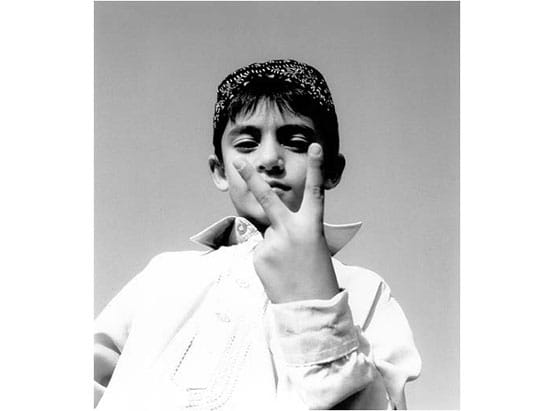
Fun-Da-Mental :Until the philosophy that holds one superior and another inferior is finally and permanently abandoned and dismantled there shall be war
Aki Nawaz sits in the dark underground studios of Nation Records in west London. He looks every inch the revolutionary. His long black hair, loosely bound by a black-and-white headscarf, falls onto a green military jacket with an Islamic lapel pin. Blanketing one wall is a giant picture of Malcolm X next to a poster advertising Nawazs band, Fun-Da-Mental.
All my life Ive fought against pathetic racism and demonisation, he says. Growing up in racially volatile Bradford in northern England, he has used his fringe punk-rock group to challenge popular conceptions of race, religion and British Asian identity since 1991. Incorporating Asian qawwali songs and African folk music into angry beats, Fun-Da-Mental were the predecessors of a long line of British Asian musicians, including the equally militant Asian Dub Foundation.
Today Nawaz is preparing to join the crowds at the third European Social Forum in London from 14-17 October, where he will support a Palestinian rights organisation. He is no forum novice. He has spent his life travelling the globe, attending forums and meetings, and translating the mood of the disempowered into music. Nawaz was among the thousands of delegates at the January 2004 World Social Forum in Mumbai. But as the ESF approaches, he feels distinctly unenthused:
One thing I cant get my head around at the social forums is all the pathetic politics. I find that peoples opinions are a bit loose. I wish they would get to the heart of the matter.
He believes that the burden of challenging the political left has been placed too heavily on the shoulders of radical artists: People within the contemporary arts scene are made into heroes for being anarchic and abusive.
Having enjoyed critical success for over two decades, Nawaz has built a formidable platform that has deeply influenced generations. Fun-Da-Mental presents itself politically, he says. Were challenging a lot of left- and right-wing ideas.
The baton should be taken by a new breed of leaders, Nawaz explains, whom he finds sadly absent within existing systems. Even people like Tariq Ali, he says of his former hero; I was stunned by what he was saying. He was playing into the stereotypical thought process of western intellectualism. He wasnt challenging it Malcolm X was challenging it, Mohammad Ali was challenging it, Marcus Garvey was challenging it.
Nawazs notorious frankness comes from a freedom he discovered through punk music and its ability to subvert common perceptions. His beliefs stem from a careful study of Islam; a faith that has liberated him. Islam for me was more punk than punk! I cant understand why people say it is restrictive, he comments.
Ive been to Dublin, Norway at the universities. But even the intellectuals, the liberals, the left-wingers, they dont have a grasp on our [eastern] culture. And when youre honest with them, they have a kind of orientalism that is their foundation. Theyre analysing intellectually and academically.
Also in openDemocracy, analysis of the second European Social Forum in Paris in 2003:
- Florent Schaeffer & Bernard Dreano, Another Europe (November 2003)
- America Vera-Zavala, Goodbye Paris, hello London (December 2003)
Drawing the poison
The politics of a person who has been the victim of racism in a town famous for its race riots, a Muslim at a time of rabid Islamaphobia, and a punk musician in an art form dominated by pop, are not always to everyones taste. But they are at least grounded in harsh reality. Im of a Pakistani background but Ive been brought up in Bradford and that gives you a cruder political view, he says.
Nawaz is the son of Pakistani immigrants, who came to Bradford in the 1960s. His father was a bus driver who spent his spare time supporting new immigrants. Politicised by his father, Nawaz witnessed the sharpest end of racist violence in Britain first hand, and has spent his life campaigning against racism.
The dominant story of British race relations during Nawazs lifetime was one of progressive improvement, but violent riots in his hometown in 2001 proved that it was far from true. Weve been fighting this big campaign in Bradford, which was really uncomfortable, not a romantic campaign at all. It was called the Fair Justice campaign for the people who rioted in Bradford, and theyd been locked away for three, four, and five years. People who had never committed a crime, got arrested for throwing a stone, he explains.
The episode also confirmed to Nawaz that he had been fighting a lost cause.
Our communities had no trouble getting on with the white community. But the white community packed their bags and left as quickly as possible. He recounts stories told to him by older Pakistani and Indian people who had to explain to all-white communities in which they lived that they were safe to live alongside, before watching white residents leave one by one.
It was the demonisation of the Afro-Caribbean community, then it became demonisation of the Indians, or the Asians or the Pakistanis or the Muslims. Im not willing to fight ignorance anymore. Because theres no excuse for it - you exist in a system where all the information is there, the education system is there, and some aspects of the system are actually quite good. For people to still live in such ignorance, such arrogance, for me is unacceptable. Theyve created the segregation and its up to them to bring about change, he says, glancing at the screensaver on his computer. An Andy-Warhol style image of Tony Blair flashes across it.
Id rather fight the system on the outside, he replies when asked if he would ever enter politics, Theres something wrong with the system. It does something to kill the aspirations of good people. It seems to be poisoned. Like a number of anti-racism campaigners, he believes that the legacy of British imperialism and colonialism has left its mark on society today. The white mans playing the game, he says angrily.
Beyond pessimism?
Despite his pessimism Nawaz believes that if there is to be any kind of revolution in social justice, it will come from the vast global communities of south Asian immigrants. The diaspora helps the people back home. My parents have done it, and where Ive done it Ive thrown money into my home country, he explains. The success of Asian and black communities away from their homeland and their ability to redistribute wealth from the rich world to the poor, using themselves as conduits, is the key to balancing economic disparity.
We have an intellectual zone, academic, left-field thinking about the big power structures. But the revolution has been happening for years. Its great. In the bigger picture, economically, we [immigrants] have kicked ass. Ive travelled a lot. Whether I go to Poland or Spain or Kazakhstan or Russia, there are Pakistanis, there are Indians, there are Africans. These countries systems are quite good at creating opportunities. Weve got to use that. I actually have more belief in Asian people spread out over the world than anyone else.
Even when immigrants come here [to the west] they make a great a contribution to society. Theyre still paying taxes. Theyre generating work and employment. Yesterday my parents came here and worked for £20 a week when everyone else was working for £100. They still started to work their way up the social ladder and did amazingly well against all the odds. Theyre still contributing, theyre still working.
Nawazs thinking has been shaped as much by the poverty of his own early years as by his experiences visiting Pakistan. People have romantic notions of what our globe should be like. I appreciate that side but I also think youve got to check in with reality and economics and get a balance on what people require. They want people to stay as they are theyre preserving poverty, he says, recalling personal stories of the street-sleepers he met in Pakistan.
openDemocracy has been present at the last two World Social Forums, in Porto Alegre (2003) and Mumbai (2004). For our reporting, comment, and argument, see our Globalisation DIY World debate
Like the battle against racism, Nawaz believes that the battle for social justice will only be won if the west looks within itself. The great revolution, or whatever you want to call it, has to happen in the west. We have to stop going to India and Africa and asking those people to sacrifice their lives. This is where the power base is. Even the people who mean well tend to think that the ones who should be sacrificing their lives are the people who are suffering rather than those people who live in a relative amount of luxury. His voice is full of undisguised bitterness. Its a great life in the west, he adds ironically, I find it hard to breathe. The air is thick with hypocrisy.
These may be uncomfortable words in the ears of those arriving at the European Social Forum. We should be embarrassed as human beings at what we have failed to achieve. The forum has to soul-search its own agenda and then its got to set a formula and go down that route. You need a structure, role-models, you need character, he insists. Nawaz wants to push the limits of civil society and use it to institute tangible change.
How much are people willing to cross over the line? he asks. The line he means is the one between talk and action, one which he thinks he has not even crossed himself. It just seems the people in the west are not willing to cross over the line.

