
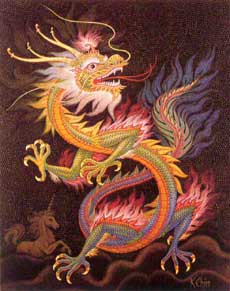
The dragon (lung) in Chinese cultural tradition is a figure very different from the malicious, fire-breathing, subterranean creature of western myth. A pervasive presence in Chinese mythology since ancient times, its forms and stories are continuously reconfigured and reinvented through popular representations and festivals. But in translation to an English name, a stepping out of one tradition into the language of another, the deep cultural traces and spirit of this protean figure intelligent, fortune-bringing, yet elusive and ever-changing are lost.
Its elusiveness starts with its mysterious origin. The fact that no one, not even descendants of the dragon, has ever claimed to see the real lung only fertilises its rich life in the Chinese imagination.
The dragon is a hybrid creature with nine characteristics: a camels head, a deers horn, a hares eyes, a bulls ears, an iguanas neck, a frogs belly, a carps scales, a tigers paws, and an eagles claws (and, some say, a humans face). In representing eternity, it has nine times nine scales the extreme of a lucky number. It traverses different realms of nature, making itself visible or invisible between heaven and earth.
The lung occupies a central place in Chinese imperial iconography of absolute power. It appears as a motif in the palaces and ceremonial dresses of numerous historical dynasties, and even in the way the landscape (fengshui) itself is aesthetically perceived and ordered. More recently, the modernising, progressivist ideology of the post-1949 Peoples Republic of China views the dragon with suspicion as imperial and monarchist.
But it is syncretic Chinese belief systems, rather than politics or ideology alone, which better express and accommodate the dragons range of meanings for Chinese people. Among my family in Hong Kong, for example, I would feel quite comfortable within a single day visiting a Buddhist temple, watching a Christian mass happening in California, and consulting I-Ching (the book of changes, an ancient book of divination with six hexagrams each representing a different state of the dragon, which later inspired both Confucianism and Taoism). The flexibility (not fixity), synchronicity (not causality) and chance (not sequence) of such daily life-rhythms mirror the dynamic movement of the lung itself. The dragon can also symbolise the real changes taking place inside and around us, speaking to our multiple desires and concerns.
One of its layers of meaning is for me especially personal. Temple Street in Hong Kongs Kowloon (literally nine dragons) district is a bustling tourist site with many food and clothing stalls, traditional clinics, sex-workers and fortune-tellers. Before my parents got married, a fortune-teller there told my father who was born in the year of the dragon that the marriage would not last, on the grounds that my mother had the eyes of a phoenix. They did indeed get separated in the end. This was a paradox to me, as the two mythic creatures were supposedly paired. Now, I am starting to understand. Pairings, in life as in mythology, are not fixed.
The complex, multiple reality of the lung is also part of my own long, soul-searching journey. By looking on the human face of the dragon, the knowledge of how we came to be who we are and the diverse paths and possibilities open to us are brought to light. The destinies embodied in the character of the dragon shape, but do not predetermine, our fate. Like dragons, we must learn to take the chances and to pursue the middle way, neither exceeding nor diminishing our strengths. Then and then only, the promise of blessing will come.
