
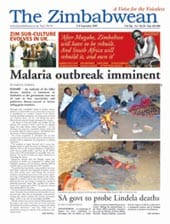
- Zakeus Chibaya, Harare The politics of malaria
- Gloria Moyo, Oakington Diary of a detainee
- A Zimbabwean correspondent, Johannesburg Lindela deaths inquiry
Zakeus Chibaya, Harare Politics of malaria
An outbreak of the killer disease, malaria, is imminent in Zimbabwe as the government runs out of cash to buy insecticides and politicises disease-control to favour members of the ruling Zanu-PF party.
Malaria is a virulent killer in areas where there is no access to prophylactics or remedies. Yet control of the disease-carrying Anopheles mosquitoes over huge areas of central and southern Africa can be, and indeed has been, effectively and relatively cheaply maintained for decades.
The disease is both preventable and curable. Yet the political and economic turmoil caused by the Mugabe regime has made disease control impossible. I do not anticipate that long-term, sustainable malaria control will be possible while he remains in power, says Richard Tren, director of Africa Fighting Malaria.
The control programme in Zimbabwe has not had enough money to buy insecticides, nor the necessary fuel to implement the programme in outlying rural areas.
The problem is largely financial, and it seems that Mugabe prefers to spend his money on shopping trips to Malaysia and on the Central Intelligence Organisation rather than on public health, says Tren. In the 2003-04 season only 3.4% of households in susceptible areas were sprayed far too few to make any impact on controlling the disease.
There are numerous allegations that the Mugabe regime has politicised its healthcare programme by restricting individual treatment and preventative spraying facilities to card-carrying Zanu-PF members.
The problem has been further compounded by the severe brain-drain, which has seen thousands of doctors, nurses and other health sector staff fleeing economic meltdown and political persecution under the current regime. One large, well-equipped mission hospital in the eastern highlands is without a doctor since the expatriate woman physician there fled the area during a rampage by a group of politically-motivated rapists who were attacking any woman suspected of supporting the opposition Movement for Democratic Change (MDC).
The recent Operation Murambatsvina has made things even worse. Thousands of city-dwellers have been forcibly sent into the rural areas, where they are increasingly at risk and have nothing with which to purchase the necessary preventative drugs even where they are available.
Also in openDemocracy as part of our collaboration with The Zimbabwean newspaper:
If you find this material valuable please consider supporting openDemocracy by sending us a donation so that we can continue our work and keep it free for all
Already malaria cases are increasing in Mashonaland and this going to get worse. Once they are in the rural areas these people do not have medicines or money with which to support themselves, reports Richard Tren. High levels of malnutrition among the majority of the population increase their problems.
Every week, hundreds of villagers are succumbing to the deadly disease. One cross-border trader from Gokwe, a malarial area, told The Zimbabwean:
We have witnessed many deaths from people who were evicted from urban areas. Malaria is even worse than HIV/Aids. At least that disease gives you time to seek medication. But malaria kills very quickly. In some cases people have been denied medication and not allowed to buy food from shops because they are suspected of being MDC supporters.
It would seem the Mugabe regime has added disease control and health services to its already formidable array of weapons food, rape and terror it wields against any political discontent.
The ramifications for neighbouring countries are enormous. The breakdown of malaria control as well as other health services in Zimbabwe will impact on the surrounding region particularly in view of the high levels of cross-border mobility.
Gloria Moyo, Oakington Diary of a detainee
It was night when our journey from the London suburb of Croydon ended at Oakington, Cambridge one of Britains network of detention centres which hold people from countries around the world who are seeking asylum, and whose cases are waiting to be decided.
When we entered reception, we were taken one-by-one to a private room to be strip-searched ladies by a woman officer from Securicor, men by male officers. They searched through my bag item by item I felt like a terrorist or a criminal. They decide which items you need and which ones you do not. They decided that I did not need my mobile phone, my makeup, my bankcards, and some of my creams. After they have sorted through your belongings, they give you what they decide you need clothing, money (not more than £10), soap, toothbrush.
I was then given my identity block and bed number (e.g. Block 38 Bed 2a would be 38/2a). You are allowed to make one phone call before you are escorted to your bed.
In my "dormitory" just like at boarding school! two officers on night duty allocated my bed. There are about eight detainees in each dormitory, with communal facilities shower, bath, toilets (the worst part of the whole experience was the bathrooms and toilets; they were filthy, disgusting and very unhealthy). The dormitories were in three sections female, male and married. We were not allowed to go into each others sections. I was told to be in bed by 10pm, and up by 7am to wash and be ready for breakfast at 7.30am.
The programme for the day was strict. 7.30am, roll call in TV lounge; 8.00am, breakfast in dining-room; after breakfast, you are free to wander or loiter around the complex; 9.00am, tea break; 12.00, roll call in TV lounge; 12-1pm, lunch in dining-room; 3pm, tea break; 5pm, roll call in TV lounge; 5.30-6pm, supper in dining-room; 10pm, you have to be in bed.
I was given an ID card that tells you when you shall be interviewed by the Refugee Council; when you shall have the asylum interview; and when you shall get your decision.
The next day I met some of the other detainees, and was welcomed by my fellow Zimbabweans three ladies. I was very depressed and broke down in tears several times, but these ladies comforted me. They sat down with me and told me about the routine. After breakfast we met with some male Zimbabwean detainees.
After meals, we would meet in groups outside the dining room or in the library, country by country. There we could comfort each other, meet with new detainees, discuss our fate. There is also a church and a gym complex. This was the daily routine for the twelve days I was at Oakington.
The food was ok, quite varied. Breakfast consisted of cereal, juice, toast and sometimes even a cooked meal. Lunch and supper were also three-course from soup to sweet. When you entered the dining-room they would tick your name. If you didnt come they wanted to know why. I never missed my meals because the meetings afterwards were something to look forward to.
The twelve days passed in a blur every one the same. I made some phone calls, but making calls to family and friends on the payphone was very expensive and you have to have loads of coins, especially to phone your lawyer. Detainees are allowed to receive calls from 10am to about 6 pm; but incoming calls are limited, they do not put them all through.
The Refugee Council interviewed me, asked about my welfare and offered to organise legal representation. On day six I had an asylum interview my lawyer and an immigration officer were present, if I had wanted one they would have provided an interpreter. By day ten there was supposed to be a decision on my case, but it was postponed because they said they could not find my file. I was very anxious and worried. I phoned my lawyer but he said there was nothing he could do.
The time dragged and eventually after lunch the next day I was told my case had been refused. I was very disappointed and decided to appeal. But at least I was free to leave the centre at last. The following morning I was called in to see the Refugee Council again. They gave me a ticket to where I was going and two weeks allowance, £80. They told me I was not allowed to work, and I had to stay at the address I had given them.
I got a new identity card (ARC) and was fingerprinted. I got my confiscated property back. After lunch I was escorted to a bus with other released detainees. Our bus passed through two checks before we left Oakington to go to Cambridge train station where we were all going to board our trains home.
(Gloria Moyo is a pseudonym)
A Zimbabwean correspondent, Johannesburg Lindela deaths inquiry
A commission of inquiry has been established to investigate the twenty-eight deaths at South Africas notorious Lindela Repatriation Centre. The minister of home affairs, Nosiviwe Mapisa-Nqakula, in announcing the decision to parliaments home affairs portfolio committee, promised that the inquiry would be conducted in a transparent manner and its findings circulated to members of parliament.
In a submission to the committee, the Zimbabwean Exiles Forum said it had irrefutable evidence of past and ongoing human rights violations affecting asylum-seekers and refugees in South Africa.
It is a tragedy of the highest order that South Africas so-called quiet diplomacy ostensibly seeks to help Zimbabwe, yet Zimbabweans are dying in that country because of its inaction in tackling the human rights disaster in Zimbabwe, the forums executive director, Gabriel Shumba, told the committee. He continued:
Issues of concern include asylum seeking procedural hurdles, the gruelling repatriation process, cases of ill-treatment, torture, inhuman and degrading treatment, lack of sanitary facilities, lack of medical attention, death, allegations of sexual molestation, a legal framework that needs review and lack of basic humanitarian support South Africa must not only be proudly South African but deservedly must be proud to be host to potential victims of genocide, torture and crimes against humanity.
The Zimbabwean recently reported that twenty-eight refugees had died at Lindela in unclear circumstances between January and July 2005. It is believed that most of them were Zimbabweans. Asked about the cause of the deaths, the minister said they had been due to natural causes the result of disease. The minister said that, in the interests of transparency, post-mortems had been conducted a claim that contradicted minutes of a previous meeting, where officials said that post-mortems could not be conducted because they were unable to locate the relatives or get permission from Zimbabwes embassy in South Africa.
Nosiviwe Mapisa-Nqakula also promised two important decisions regarding South Africas obligations to refugees. She admitted that:
poor department interventions to deal with application backlogs had undermined their moral and legal obligations to refugees certain applicants had been waiting for at least ten years to receive their confirmation of status. Failure to confirm their status resulted in poor living conditions for the refugees.
Although the minister appeared before the committee, officials from her department failed to attend the meeting, according to minutes in the possession of The Zimbabwean.

