
- Wilf Mbanga: Secret deal to train black pilots
- The Zimbabwean, Harare: Confusion reigns as MDC rebels register
***
Secret deal to train black pilots
By Wilf Mbanga in London
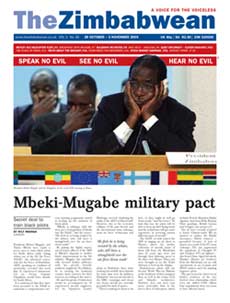
Presidents Robert Mugabe and Thabo Mbeki have made a secret pact to train black pilots for South Africa while easing whites out of the South African Air Force (SAAF). An informed source from the Air Force of Zimbabwe (AFZ), speaking on condition of anonymity, revealed this week that fourteen experienced instructors, led by a Group-Captain, would leave shortly for South Africa.
It is understood that they have been seconded to the SAAF to undertake a comprehensive two-year training programme aimed at beefing up the numbers of black pilots.
The Zimbabwean
Mbeki is unhappy with the slow pace of integration of blacks into the SAAF, said the source. He feels he is being resisted by the whites, who still have a stranglehold over the air force down south.
By putting the highly experienced senior officers of the AFZ at Mbekis disposal to further black empowerment in the South African military, Mugabe has undoubtedly secured increased influence with his already friendly southern neighbour. In addition, he is earning his bankrupt country hard currency for their services, according to the source.
The source said that the group of instructors would be accompanied by thirty experienced aircraft engineers, led by Squadron-Leader Mudenge, severely depleting the ranks of the AFZs technical staff. However, due to the economic collapse of the past decade and the international arms embargo, most air force technicians and pilots in Zimbabwe have done nothing but twiddle their thumbs for some time now. In addition, Zimbabwe lost several aircraft in the Democratic Republic of Congo campaign and about two dozen aircraft are currently grounded for lack of spares.
Theres nothing for them to do here, so they might as well go down south, said the source. At least that way the pilots will be able to keep up their flying hours and the technicians will get some experience in servicing various different types of aircraft.
The SAAF recently joined the AFZ in staging an air show in Harare, where the motley collection of aircraft, many of them still from the Rhodesian days twenty-five years ago, were put through their faltering paces in the skies over Harare. Fancy jets were brought in by the South Africans to beef up the display.
Zimbabwean pilots still use second world war-era Dakotas as the backbone of their transport fleet, as well as the Cassa C212 and Islander workhorses. Nowhere does east meet west more noticeably than in the forces fleet of helicopters, which includes French Alouettes, Italian Agustas, American Bells, Russian Hind gunships, British Lynxes and Cougars.
The air force recently acquired a dozen Chinese-made K8 jet trainers to replace the British Aerospace Hawk trainers grounded because of lack of spares, as a result of the EU arms embargo. The jets augmented the squadrons of Chengdu F7 and Guizhou FT7 jet fighters also from China. Aged but sturdy Hawker Hunter jet bombers from the Rhodesian era are still operational, as are Cessnas and SF260 trainers used for training beginner pilots.
The pact is seen by observers as further evidence of the two leaders close relationship, which even the stalled US$1 billion loan negotiations does not seem to have affected.
***
Confusion reigns as MDC rebels register
The Zimbabwean correspondent in Harare
The champagne corks must be popping at shake-shake house, the headquarters of Zanu-PF, over the crisis in the MDC. President Mugabe himself has come out on the side of the pro-Senate group and accused Morgan Tsvangirai of behaving unconstitutionally. Even senior civil servants like George Charamba, the permanent secretary for information, have joined the Tsvangirai-bashing orgy and accused the MDC leadership of flaunting its greed and selfish interests.
The minister in charge of the Central Intelligence Organisation (CIO), Didymus Mutasa, has openly boasted that the Zimbabwe spy agency has been involved in aiding and abetting the crisis. What is surprising is that some of the MDC leaders, who have been quiet for the past five years, have ferociously attacked Tsvangirai in the past few weeks. Not even Mugabe himself has been so viciously attacked by these rebels.
These articles were originally published in the weekly newspaper The Zimbabwean, which has regular analysis, features, discussion and up-to-the-minute reports on Zimbabwe. You can read it online here
For more about Zimbabwe on openDemocracy, click here
For a party that has defied murder, threats, harassment, intimidation, rape and abuse of the judicial process to fall apart over an issue like the senate defies belief. Certainly, Mugabe knows that, in a country where the majority of the people are hungry and jobless, he only has to throw a few crumbs to get his opponents to tear themselves apart and get their snouts into the trough.
Zimbabweans are surprised to find that Mugabe is now actively encouraging the MDCs participation in the Senate, when, during past elections, he has denounced them as traitors and agents of imperialism. Why is he now welcoming Blairs boys to participate, when in the past he has sent hordes of his thugs to intimidate opposition supporters? Why does he want them to participate now?
Another interesting development has been the invitation to six MDC rebels to visit Pretoria by South African President Thabo Mbeki. The spectacular failure of his quiet diplomacy in bringing Zanu-PF and the MDC to the conference table to thrash out their differences is well documented. Yet now he puts himself out to speak to one group in the senatorial dispute. In the past he has always told the world to mind its own business, as the Zimbabwe crisis was an internal matter. On more than one occasion he has said it was up to Zimbabweans to solve their own problems. Why is he now getting involved in an internal dispute within the MDC?
Another confusing dimension has been the announcement by MDC MP Job Sikhala that the party received some money from Ghana and Nigeria and control over these funds is the real reason for the infighting. Although the leadership has vehemently denied this, it raises questions that need to be answered.
One of the leading rebels, Paul Themba Nyathi, issued a very clear statement soon after parliament had passed the constitutional amendment number 17. The creation of a senate is in no way a move to improve legislative oversight. It has simply been created as an extension of presidential patronage, aimed at soothing bruised egos within the ruling party. The new constitutional provisions represent a serious assault on citizens basic rights and freedoms, said his statement.
During the debate on the bill, Welshman Ncube, another rebel, said it was a systematic retrogressive move for the country. It will exacerbate the crisis of governance. It is remarkable that these two gentlemen have departed in so short a time from their statements. Such political somersaults surely deserve some explanation. What has changed?
All these things contribute to the suspicion that money has changed hands. Some reports say Mugabe allocated as much as $15 billion to the CIO for the purposes of destabilising the MDC.
The alleged emergence of an ethnic fault line deep within the party is perhaps the most disturbing of all. Tribal politics are dangerous and some commentators have already portrayed the split as having taken a clearly ethnic line, with mainly southern provinces populated by Ndebele-speaking people rooting for Ndebele-born secretary general Welshman Ncubes pro-participation position (Zimonline, 25 October 2005 ). But this oversimplifies the issue. The divide is not that straightforward at all. For example, two of the six rebels, Gift Chimanikire and Isaac Matongo, are both Shona speakers.
Tsvangirais handling of the senate dispute has been clumsy. The bottom line is that the MDC national council voted to participate in the election and he subsequently tried to nullify that vote. The whole thing was messy but he opened himself to accusations of acting undemocratically. Despite the fact that most Zimbabweans agree with his position that the MDC should not participate, and therefore legitimise, the senate elections, he has not come out of the tussle at all well.
How Tsvangirai manages the crisis over the next few weeks will be the toughest test of his leadership skills to date. He has the majority of ordinary Zimbabweans behind him. That fact must surely give him confidence to adhere to the high principles which have brought him this far.

