
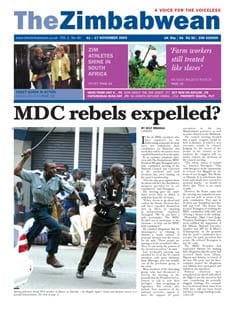
If the twenty-six Movement for Democratic Changes (MDC) members who have registered for Zimbabwes senatorial elections due on 26 November have not withdrawn their candidature by this Saturday, 12 November, they will be deemed to have expelled themselves from the party.
In an exclusive telephone interview, MDC president Morgan Tsvangirai told me that a duly constituted meeting of the partys national council was convened on the weekend of 5-6 November and took decisions that were binding on the partys membership. The meeting gave the candidates seven days in which to withdraw from the elections.
Anyone who goes against these decisions will face the disciplinary measures provided for in our constitution, said Tsvangirai. If they choose to go ahead and contest the senate elections they will have expelled themselves and, in effect, be standing as independents, he continued. We do not have a split personality. The MDC decided not to participate in the elections so how can the MDC field candidates?
Wilf Mbanga is editor of the weekly newspaper The Zimbabwean
openDemocracy articles on the Zimbabwes humanitarian and political crises include:
Andrew Meldrum, Who won Zimbabwes election? (April 2005)
Wilf Mbanga, The end of Mugabe? (October 2005)
If you find this material valuable please consider supporting openDemocracy by sending us a donation so that we can continue our work
Tsvangirai rebutted allegations that his intransigence in refusing to dismiss a mafia cabinet of personal advisers was the reason for the split. These people are managers in the presidents office. They do not usurp the powers of the elected executives, he said.
Last weekends meeting was attended by fifty-two of the sixty-six council members, with party chairman Isaac Matongo, who was initially one of the pro-senate group, in the chair.
Most members of the dissenting group, who had threatened to boycott the meeting on the grounds that the president had no powers to call it, sent their apologies thus recognising its legitimacy. The rebels, who include four members of the national executive, appear to have the support of party executives in the two Matabeleland provinces as well as some districts in the Midlands.
The council meeting decided that a party congress would be held in January 2006, at which a new executive would be elected. Judging by the mood of the people in the country at the moment, the congress will, no doubt, endorse the decisions of the council meeting.
The whole nation is behind us, asserted Tsvangirai. This crisis has given us the opportunity to re-focus. Let Mugabe be the focus of our struggle. Not Welshman Ncube or Gibson Sibanda [MDC secretary-general and vice-president respectively]. It is unfortunate that some individuals have resorted to personal attacks we should be above that. There is too much at stake.
However, the Ncube camp said the meeting was unlawful because it was not held in accordance with the terms of the party constitution. They said its decision was fraudulent and thus null and void. The faction has accused Tsvangirai of violating the MDC constitution willy-nilly and of being a dictator in the making.
Today, 11 November 2005, is the fortieth anniversary of the unilateral declaration of independence by Ian Smith, the prime minister of Rhodesia the country that became Zimbabwe in 1980.
For a memoir of a man who lived through the period, see: Emily Barroso, A Zimbabwean life (April 2005)
Meanwhile, high court judge Paddington Garwe this week nullified the suspension of Job Sikhala, national executive member and MP for St Mary's (Chitungwiza) on the grounds that the party's constitution does not give the party president that power. He ordered Tsvangirai to pay the costs.
The MDC president had suspended Sikhala for making false allegations that the party had received funds from Ghana, Nigeria and Taiwan, in breach of the law. The party and the three countries denied the allegations and Sikhala then apologised and withdrew the statement.
Political observers have remarked at the speed with which the high court has moved in this case, considering its normally sluggish dealings. For example, several electoral fraud cases from 2000 have still not been heard and there is a huge backlog on the court roll.
The troubles for the MDC are clearly far from over.

