
***
Party faithful, not people power
Tendai Moyo observed the celebrations in Harare and Masvingo that followed the passing of a constitutional amendment bill with a sinking heart.
The Zimbabwean
The ruling party was at it the whole of last week with its supporters taking to the streets of Harare celebrating the constitutional amendment bill that was bulldozed through parliament in a vain attempt to put an end to the land reform squabbles.
Zanu-PF took advantage of its numbers in the August house and the bill was passed effortlessly. However, from a survey carried out by this newspaper it is clear that the ruling party supporters do not know the basic tenets of the bill and are only following in the shadow of their masters.
Speaking in Masvingo the beleaguered former Minister of Industry and International Trade, Samuel Mumbengegwi, indicated that the bill would uplift the lives of people on the farms. What he failed to see was that there are no inputs for the crops and the resettled people have no real knowledge of farming on a commercial scale.
You are going to be empowered as a people, thundered Mumbengegwi at victory celebrations in Masvingo. The government will no longer be dragged to the courts by the whites and you can now settle comfortably at your farms, he added, to much applause from the supporters.
It was the same across the whole country as the issue of empowerment through the bill the ruling partys trump card was played up. What the politicians failed to address, however, was exactly what the bill curtails and entails for the people themselves.
We were just told that there were some celebrations going on about a bill that has been passed in parliament but I really dont know what it is all about, said a party supporter in Masvingo, We were just taken here by the lorries to be addressed and to celebrate this as a victory against Tony Blair and the MDC. But we dont even know what we are celebrating about.
Such situations indicate the ignorance of ruling party supporters a bunch of people who just fall in with whatever has been said by their party superiors. At the rallies one could actually tell that the peasants who had been bussed in did not know why they were there except that it was a rally held by the ruling party.
Zanu-PF has always used to its advantage the ignorance of its supporters to spearhead what it terms garnering support from the common people and to make their totalitarian rule appear people-oriented.
Analysts have indicated that ruling party supporters will wake up and find that all is not as rosy as the party chiefs tell them. As one commentator observed:
The bill provides for all land-dispute court cases to be thrown out and people will settle on any designated farms - but the painful truth is that they will do so without any inputs or capital to make the country a bread basket again
back to top
Zimbabweans in South Africa: new report
The Zimbabweans correspondent in Johannesburg details the findings of a new survey of the lives of Zimbabweans who have fled their native land
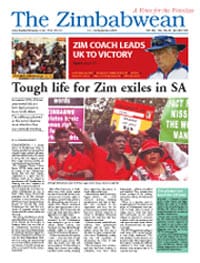
A sample survey of Zimbabweans living in the Gauteng province of South Africa provides a worrying picture of people, the majority of whom are without legal status, who have suffered violence or torture at home, who now support others from meagre incomes, and who are nervous about being interviewed.
These articles were originally published in the weekly newspaper The Zimbabwean, which has regular news, analysis, features, discussion and up-to-the-minute reports on Zimbabwe; its online version is here.
The Zimbabwe Torture Victims Project (ZTVP) which carried out the survey of 236 Zimbabweans during July and early August, emphasised in a report that the findings could not be judged as representative of all Zimbabweans in Gauteng, but were indicative of particular trends and conditions.
It is estimated that more than one million Zimbabweans are now in South Africa, having fled political persecution or the dire economic conditions in their homeland. The ZTVP was set up in January this year because of concerns that many Zimbabweans who had fled were victims of organised violence and torture and thus needed medical and other help.
The survey, titled Between a Rock and a Hard Place, was also a project of the Institute for Democracy in Southern Africa. Just over 50% of the Zimbabweans interviewed for the survey came from Matabeleland, the heartland of political opposition to Robert Mugabes Zanu-PF, and only 3% from Mashonaland. Most were men (141), 156 said they had one or more children, and almost all were young 29 was the average age for the male and 27 for the female respondents.
Most (85%) had come to South Africa since 2000, which marked the start of the critical decline of the economy and of human rights in Zimbabwe, and 20% had arrived in the Johannesburg area this year. A massive 80% of those interviewed did not have legal permits to be in South Africa. Most of those who did have legal status had either asylum applications or refugee status.
The report said that, overall, an estimated 10,000 Zimbabweans have managed to get on to South Africas asylum process, but thousands more have failed, despite the fact they were probably eligible in terms of the countrys international obligations.
Of those interviewed, the majority 73% cited their lack of legal status as a major concern. The other big worries were jobs and accommodation. Of those willing to divulge their income, 72% were making less than R1,500 a month ($235, 190, £130), including those supporting dependents in South Africa and at home.
Asked why they had left, the single biggest number 131 cited economic reasons, including unemployment and lack of food. Just over one third of the respondents said they left for political reasons, and 30% said they had been directly subjected to torture in Zimbabwe. 44% also said they had been refused access to food.
Of those tortured, nearly half were suffering from a psychological disorder, said the report. The authors noted that this was a relatively low figure compared with other recent Zimbabwean studies, but was still significant in determining the kind of help needed by refugees.
The interviewees, 62% of whom said they had been working in Zimbabwe, were from varied backgrounds skilled, semi-skilled and unskilled. They included four former members of the military, seven police officers, fourteen teachers and five nurses. The report concluded:
There is a pressing need to understand better the position and plight of Zimbabweans who have come to South Africa in search of refuge, and to ensure that those who legitimately can be called refugees as opposed to economic migrants receive the treatment and care expected under South African and international law.
The ZTVP suggested extending its small survey so the national picture is more clearly understood. The way forward is neither rhetoric nor denial, it said. Better data leads to better policy. Certainly, the suffering indicated in this small survey deserves more attention than it is currently receiving.

