
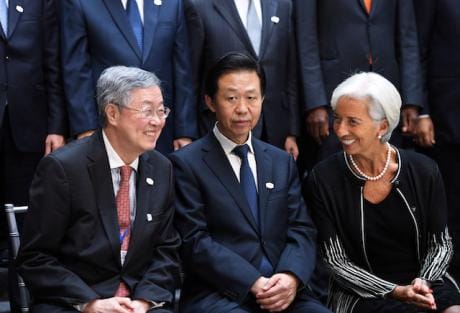
Christine Lagarde, Chinese Finance Minister Xiao Jie and China's central bank governor Zhou Xiaochuan(left)in G20 Finance Ministers'group photo, 2017. Xinhua/Press Association. All rights reserved.
September 2011, three years after the collapse of Lehman Brothers, public anger with the Great Financial Crisis boiled over right where it all started: Wall Street. The austerity measures taken in response to the crisis and the failure to hold bankers to account led a large group of activists to ‘occupy Wall Street’. Inspired by the Arab Spring, the idea was to keep public space occupied until there was a change benefiting ‘the 99%’.
Within weeks, hundreds of protests and ‘occupy’ camps had sprung up in major financial centres around the world. Not since the heydays of the East Asian financial crisis had global finance come under such sustained criticism from civil society organisations (CSOs) and never – in my lifetime – had this led to such mass mobilisation demanding radical reform of the global financial system.
