
More interviews with filmmakers on openDemocracy:
"Offside rules: an interview with Jafar Panahi (June 2006)
"Wal-marts bargaining power: an interview with Robert Greenwald" (May 2006)
"Between Pakistan and the world: an interview with Sharmeen Obaid" (July 2004)
"Osama and Afghan cinema: an interview with Siddiq Barmak" (March 2004)
"10 x Ten: Kiarostamis journey"
(December 2002)
Listen to Mark Hanrahan talk to Chris Gorak, writer-director of Right At Your Door, and actor Rory Cochrane (9.47mins)
High bandwidth: 128kbps / Low bandwidth: 64kbps
For the populations of many cities around the world, the threat of terrorism is now a fact of life. As the fifth anniversary of 9/11 approaches, another fact of life that many urban-dwellers will have to face is the string of terrorism-themed movies hitting their local cinemas: Oliver Stone's World Trade Center and United 93 being the most high-profile examples.
First-time director Chris Gorak's Right At Your Door differs from the aforementioned films, firstly because it deals with a fictional terrorist attack, and secondly through it's more nuanced examination of the experience of a terrorist attack.
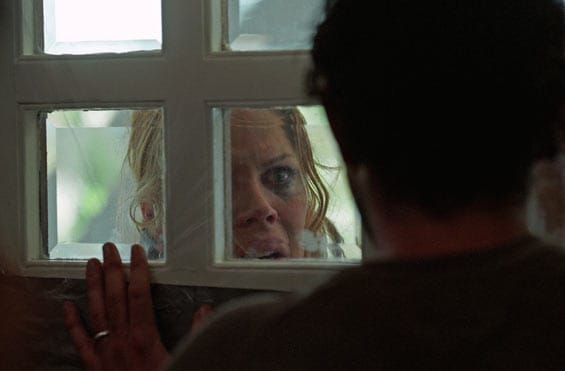
A Los Angles couple, unemployed Brad (Rory Cochrane) and his breadwinning wife Lexi (Mary McCormack) start a day like any other, until their routine is shattered by the detonation of multiple 'dirty' chemical bombs in downtown LA, right by their neighbourhood. After a fruitless search for his wife, Brad goes home and, following instructions from the authorities, seals himself in his house, to avoid contamination from the cloud of poison ash that is slowly blanketing his district. When Lexi finally makes her way home, Brad is faced with a dilemma: ignore the advice of the authorities and let his contaminated wife into the house – which could contaminate and kill him – or keep her outside and wait for help?
Gorak did not have a massive budget to play with making the film, and some of the cost-cutting measures that he employs work in the film's favour. There are very few CGI shots in the film (preventing it from going down the Independence Day route) and almost all the action takes place in Brad and Lexi's now plastic-encased house, putting the viewer in the same claustrophobic space as Brad. There are no shots of the carnage downtown, either from the camera's perspective or from TV – Brad gets all of his information from listening to the radio, which as a dramatic device works very well, synthesising the slow drip of information that trickles down from the authorities after terrorist attacks take place.
While the film was in post-production, hurricane Katrina struck and devastated New Orleans and much of the south eastern United States. Having lived for seven years in New Orleans himself, and watching the chaos and devastation that followed, Gorak was given a uniquely bizarre perspective on the tragedy, watching elements of his story being acted out in real-life as the authorities 'red tagged' houses and left citizens stranded with only the promise that "help is coming".
Right At Your Door may lack the star-power and effect budget of World Trade Center, but is probably a better film because of it. As it is, the film makes for tense, compelling viewing, and features fine performances from Cochrane and McCormack. While the second act may not have the initial impact of the panic-drenched opening, a sense of tension and fear is maintained that keep will keep you hanging on all the way to the twist in the end.

