
Buy now: UK, US, Worldwide
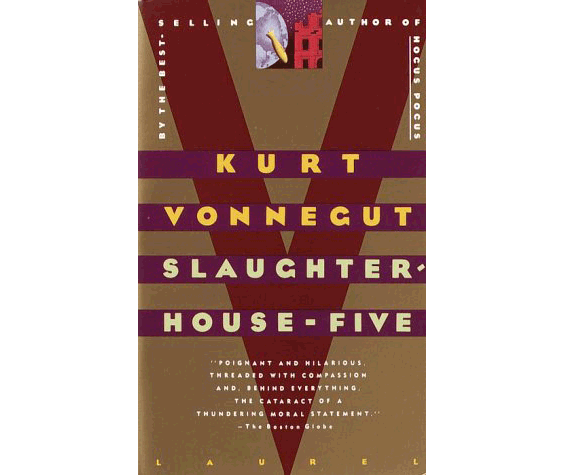
"Slaughter House Five"
by Kurt Vonnegut
Delta House | November 1991 | ISBN 0440180295
Recommended by Mark Hanrahan : I normally associate science-fiction writing with William Shatner, or with the groups of pale teenage boys who shuffle around in the dark corners of my local bookshop not with thought-provoking analysis of war and the human condition.
When Kurt Vonnegut is involved, however, expectations can often be confounded, and that is certainly the case with Slaughter House Five. This is a rare beast indeed: a science-fiction novel, incorporating aliens, historical writing and some semi-autobiographical time-travel.
Vonnegut's protagonist, Billy Pilgrim, becomes "unstuck in time" and begins re-visiting scenes from his past as well as being shown his future, in which he is kidnapped by aliens and taken to live in a zoo on the planet Tralfamadore. The scenes from Billy's past are centred around his, i.e. Vonnegut's, experiences in the Second World War. As a German prisoner-of-war he witnessed, first-hand, the fire-bombing of Dresden, and took refuge from the bombs in the basement of a slaughter house, from which the book derives its title.
Vonnegut's war is not a tale of heroes; Billy himself is more a tramp than a soldier, wandering around France shoeless, unarmed and shell-shocked. His colleagues who exhibit bravado are exposed as naïve when they meet with an untimely end, and those that survive do so by abandoning their colleagues and running for their lives.
Of particular relevance to contemporary conflicts is Vonnegut's view of the higher-ups. Stuck in a hospital bed after the war beside an officer writing a history of the war, Billy hears the man tell his wife regularly about how vital to the war effort the destruction was. After sitting mute for weeks, Billy finally informs him: "I was there I just want you to know that I saw it." A blunt riposte to the chicken-hawks of his day that has, regrettably, once again become relevant to current affairs.
What really earns Slaughter House Five the status of contemporary classic is the humour it brings to a subject that could make for a rather depressing read if played straight. Vonnegut's wit and style, evocative of Joseph Heller's subsequent work Catch 22, communicate the absurdity of war far more effectively that any sombre historical analysis of facts and statistics ever could.
* * *
About the author: Kurt Vonnegut is one of the few grandmasters of American letters, one without whom the very term American literature would mean much less than it does. He was born in Indianapolis, Indiana on 11 November, 1922. He lives in New York City and Bridgehampton, with his wife, the author and photographer Jill Krementz. His website is at www.vonnegut.com. For A Man Without a Country and Kurt Vonnegut's other works, click here.

