

When Kevin Roberts, the president of the US-based Heritage Foundation, took the podium at the fourth regional meeting of the right-wing Madrid Forum in Santiago, Chile, last month, he and his foundation had much to celebrate.
In much of Latin America, until last decade a bastion of progressive and centre-left, far-right governments have surged to power on platforms that seemed inspired by Project 2025, an authoritarian blueprint, accompanied by a 900-page manual, that first came to prominence in the US president Donald Trump’s second presidential run in the United States.
Project 2025 did not start the global ultra-conservative surge that continues to claim fresh victories in Latin America and Europe. Across the world, a network of organisations – largely based in the US, Europe and Latin America, and rooted in Christian nationalism – has sought to fund, train and develop conservative activists in an effort to roll back rights and civil liberties. The Heritage Foundation is one of many organisations working to advance a conservative agenda.
But in his speech, Roberts said his foundation was “proud to have helped unify this movement”.
Roberts was far from the biggest draw at the conference. Speakers at the Madrid Forum included Chile and Argentina’s far-right presidents José Antonio Kast and Javier Milei. But his presence in Santiago and his regional itinerary reveals the expanding influence of Project 2025 south of the US border.
The Chilean capital was not the only destination in Roberts’ whistle-stop tour of Latin America last month. He also visited Colombia, where he met with senior members of government in the newly elected president Abelardo de la Espriella and offered to provide “training” to Colombian civil servants.
President de la Espriella – who has been photographed posing the bodies of alleged militants slain by his security forces and whose government Roberts praised as “impressively bold” – took office at a religious ceremony at which he vowed to “put God at the centre of every decision”.
In Peru, Roberts’ visit was around the same time as the country’s new president Keiko Fujimori – the daughter of one of Latin America’s most brutal dictators, Alberto Fujimori – met with US secretary of state Marco Rubio in Lima and announced her support for the ‘Shield of the Americas’, an informal alliance between the US and like-minded governments to enable intelligence-sharing and expand Washington’s military action in the region, ostensibly to combat ‘narco-terrorism’.
Here, Roberts emphasised the strategic importance of Latin America in realising the ‘America First’ policy.
God’s Plan
Project 2025, and its 900-page Mandate for Leadership, was drafted by the Heritage Foundation with the support of more than 100 Christian nationalist organisations in the US with the aim of laying out an agenda for Donald Trump’s second presidential term.
Its agenda includes a hard line on immigration, with widespread arrests and deportations and the gradual erosion of the right to asylum; tax cuts for the wealthiest; the dismantling of environmental and health protections; restrictions on trade union rights; the withdrawal of benefits for single-parent families; the dismantling of public education; an absolute ban on abortion (even invoking an anti-obscenity law from 1873) and restrictions on access to contraception.
While Trump publicly distanced himself from the project, his administration passed around half of its policies in his first year in office. Rights organisations responded with alarm, with the Global Project Against Hate and Extremism warning: “Within this worldview, pluralism, gender equality, and LGBTQ+ rights are treated not as democratic principles but as threats to a divinely ordered society.”
Yet, as Roberts’ Latin America tour demonstrated, Project 2025 is not only being used to roll back rights in the US. Its policies are being implemented by right-wing presidents in Argentina, Chile, Colombia, Costa Rica, El Salvador, Honduras and Peru, and its ideas and influence can be seen in speeches, narratives and campaigns promoted in media and social media campaigns across much of Latin America.
Putting this mandate into practice runs counter to democracy – a fact its proponents barely bother to conceal. “Elections are not enough, not anymore. Elections are only the beginning of the political process. What really matters is what conservatives do with political power when we have it,” Roberts told the Madrid Forum audience.
 Diana Cariboni
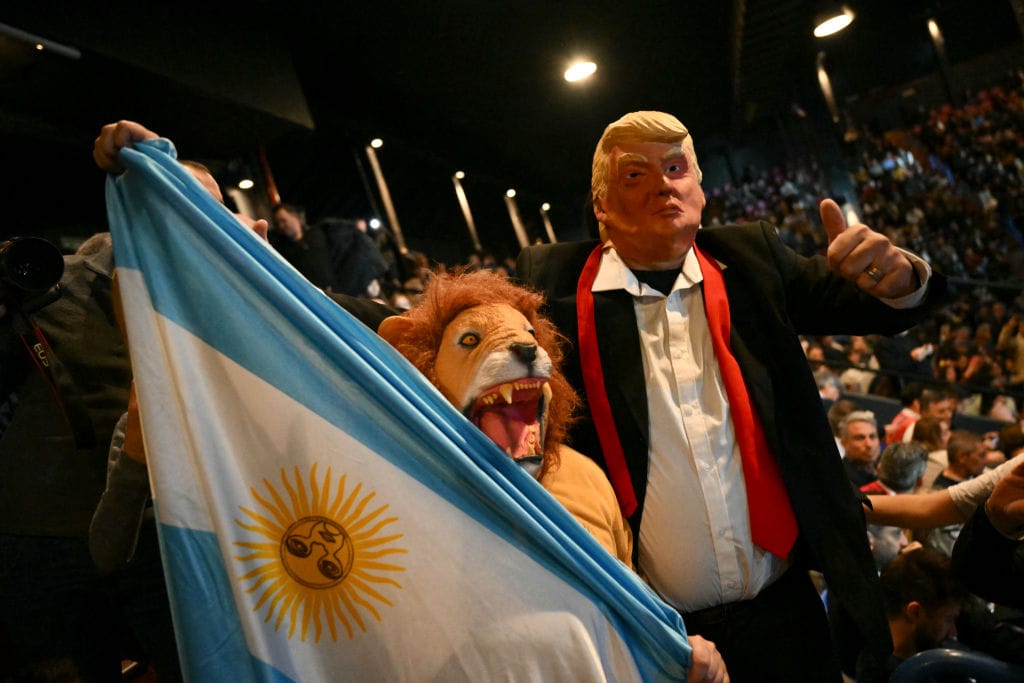
At the Madrid Forum, Roberts said the West “is the foundation of our very mindset that God – no man or government – is who creates our freedom”.
This is key to Project 2025’s evangelical ideology known as the ‘Seven Mountains Mandate’, which says Christians must dominate seven spheres of human life: family, religion, education, the media, arts and entertainment, the economy and government.
Right-wing political leaders across Latin America have taken up this call, despite some of them previously expressing ambivalence or rejection about religion.
Former Brazilian president and Trump acolyte, Jair Bolsonaro, had an evangelical pastor baptise him in the River Jordan in 2016 shortly before his presidential campaign, and used to finish his speeches with the phrase “God above all”. De la Espriella of Colombia described himself as an atheist before entering politics, but now ends his public appearances by shouting “Long live Christ, the King”.
Argentina’s Milei has publicly mused about converting to Judaism, and recently told an audience of teenagers at a secondary school that, “God’s plan brings abundance and harmony. The Marxist plan is a satanic plan which, instead of bringing paradise, brings you hell”.
Chilean President Kast, on the other hand, is a lifelong ultra-conservative Catholic who set up a chapel for evangelical prayers inside the Palacio de la Moneda, the president’s official residence.
But for most ultra-conservative leaders, appeals to God and to the moral superiority of Christianity are useful rhetoric in support of causes as diverse as the defence of capitalism, the rejection of social justice and sexual and reproductive rights, and the deflection of public scrutiny of human rights violations in military operations against drug trafficking.
The new face of US power
A key aspect of Project 2025 is a radical overhaul of how the US projects power across the world. Once more, Latin America is serving as a proving ground for this new strategy.
One key proposal is “to make irregular warfare a cornerstone of security strategy”. This includes “cyber, information, economic, and counterterrorist irregular warfare capabilities”, “economic warfare, lawfare and diplomatic pressure” and “name and shame” of individuals and organisations deemed to be enemies.
In March this year, the Heritage Foundation organised the Miami Security Forum, held at a Trump group hotel, that brought together officials, politicians, and military and security experts from the United States and Latin America. The event is due to be repeated in March 2027. These regular forums are part of a wider strategy that encompasses initiatives such as the Shield of the Americas.
Project 2025 also devotes considerable space to a radical reform of soft power. Previous US governments built their global soft power in the name of promoting democracy and human rights, and furthered diplomacy through humanitarian assistance.
The Heritage Foundation, meanwhile, appeared obsessed with the need to dismantle the “corrupt” US Agency for International Development (USAID), whose name appears 156 times in the Project 2025 playbook – second only to “abortion”, which is mentioned 199 times.
Shortly after coming to power, the Trump administration cut USAID’s international humanitarian aid programmes by 80% and transferred its remaining functions to the US State Department. Brooke Nichols, an infectious disease modeller and health economist at Boston University, estimated that some 700,000 people, including more than half a million children, would die as a result of the abrupt withdrawal of USAID’s health assistance, particularly in sub-Saharan Africa. By 2030, the number of fatalities could reach 14 million, including 4.5 million children under the age of five, according to researchers from the Institute of Collective Health at Federal University of Bahia in Brazil.
As recommended by Project 2025, the Trump administration has made clear that religious organisations will be prioritised as recipients or intermediaries for what little aid remains. In August, the State Department announced some $2bn in health aid for several religious groups, such as World Vision, Compassion International, and Samaritan’s Purse. The latter organisation declined its $300m allocation, saying it has “always relied on God, not government, for funding”.
 Sian Norris
Dark money
To understand the Heritage Foundation and Project 2025’s impact in Latin America, and the complex right-wing ecosystem of networks, groups and platforms in the region, it is helpful to decode the flow of money that accompanies the flow of ideas.
Among the hundred sponsors of Project 2025, only 15 disclose international spending in their financial filings. Between 2019 and 2024, these 15 groups distributed at least $77 million to influence politics and society across five continents, according to their tax returns, compiled and analysed by openDemocracy.
Our analysis suggests that only $2.1m of this money went to Latin America (3%) and $2.7m (3.5%) was spent in Canada and Mexico. The US Internal Revenue Service (IRS) does not require the organisations to specify the countries where their money is being sent, only the region.
This is just a fraction of the regional and international spending of nearly 30 US Christian right-wing groups that openDemocracy has been tracking since 2020, when our landmark investigation revealed they had spent, between 2007 and 2018, at least 280 million dollars worldwide to advance their agenda against equal rights. Several of these groups are also involved in Project 2025.
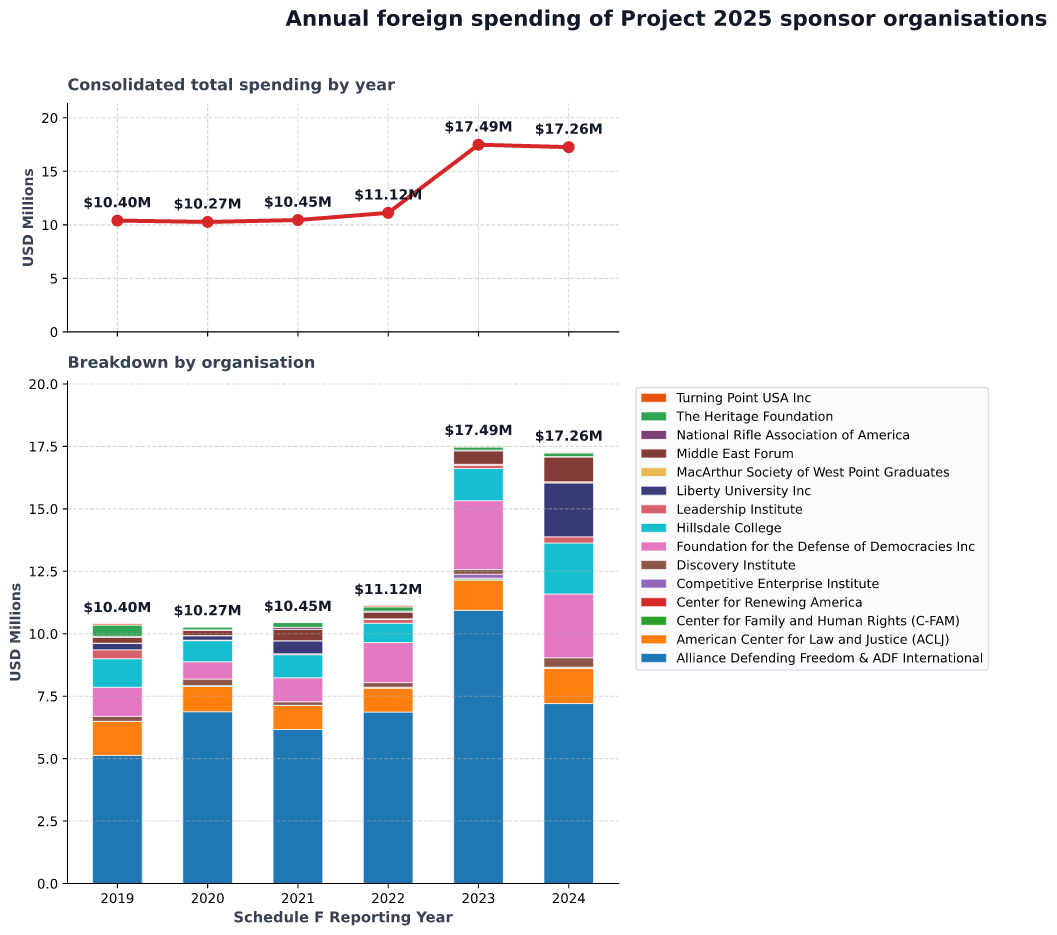
The biggest international spender in this group is the Alliance Defending Freedom (ADF), the Christian right-wing lawyers’ organisation that drafted the strategy that successfully overturned abortion rights in the US in 2022. ADF sent $43m abroad between 2019 and 2024 – almost 60% of the total amount we identified – of which it spent just over $930,000 on Latin America, Mexico and Canada. The rest of this money went to Europe, where the Trump regime has openly supported far-right political forces.
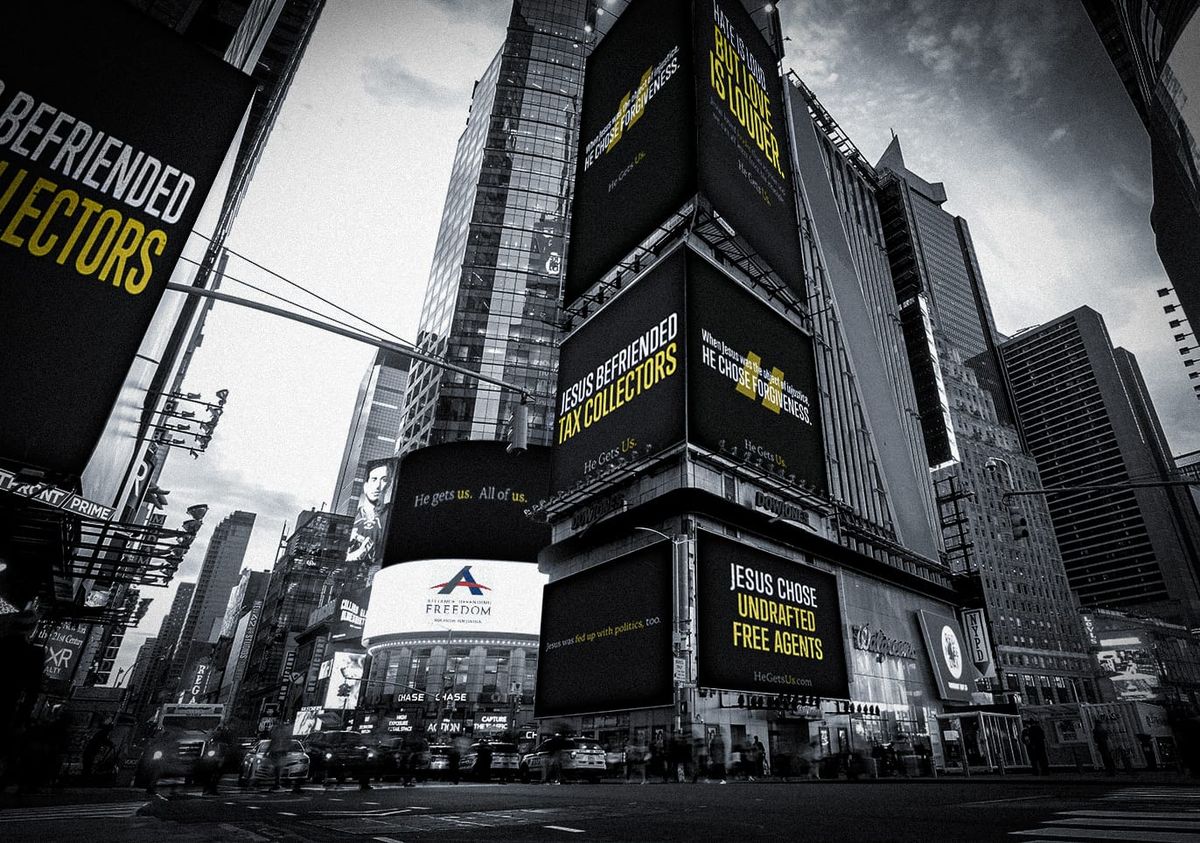
The ADF has been described as an anti-LGBTIQ hate group by the Southern Poverty Law Center, an organisation dedicated to defending civil rights. In recent years, the ADF has increased its international spending on litigation and campaigns in an attempt to export its political agenda. Its overseas arm, ADF International, has offices in Vienna, Brussels, Geneva, London, Washington and New York, and is accredited as an NGO with the UN, the OAS, the European Union and the European Parliament.
 Diana Cariboni
The second-biggest international spender is the Foundation for the Defence of Democracies (FDD), a pro-Israeli think tank that denies the genocide in Gaza and is opposed to Iran, China, Russia and Turkey. Over the six-year period, it spent $9.m abroad, of which $8.8m went to the Middle East and North Africa.
A spokesperson for the FDD answered over email: “The Foundation for Defense of Democracies (FDD) was not and has never been a part of Project 2025. FDD was included in the announcement in error, and it was quickly corrected once known to us”. However, the organisation is listed as a Project 2025 advisory board member in the Mandate for Leadership book, published in April 2023, and included as such in Heritage’s press releases in May 2023, October 2023 and February 2024.
The spokesperson didn’t answer our questions, but added: “FDD is a nonpartisan research institute focusing on national security and foreign policy.”
The American Centre for Law and Justice (ACLJ) – led by Jay Sekulow, a former Trump lawyer – distributed $6.9m, all of it in Europe. In 2020, openDemocracy revealed ACLJ was donating money to a Russian evangelical group linked to Putin. The organisation, which focuses on litigating cases against abortion and in favour of religious freedom, has offices in Israel, France, Pakistan and Zimbabwe.
Two ultra-conservative universities are among the biggest spenders: Hillsdale College ($7m), of which around $900,000 went to Latin America, and Liberty University ($3m, with $500,000 sent to the region. Most of these funds were allocated to student grants, trips to carry out ‘missions’ or studies abroad,
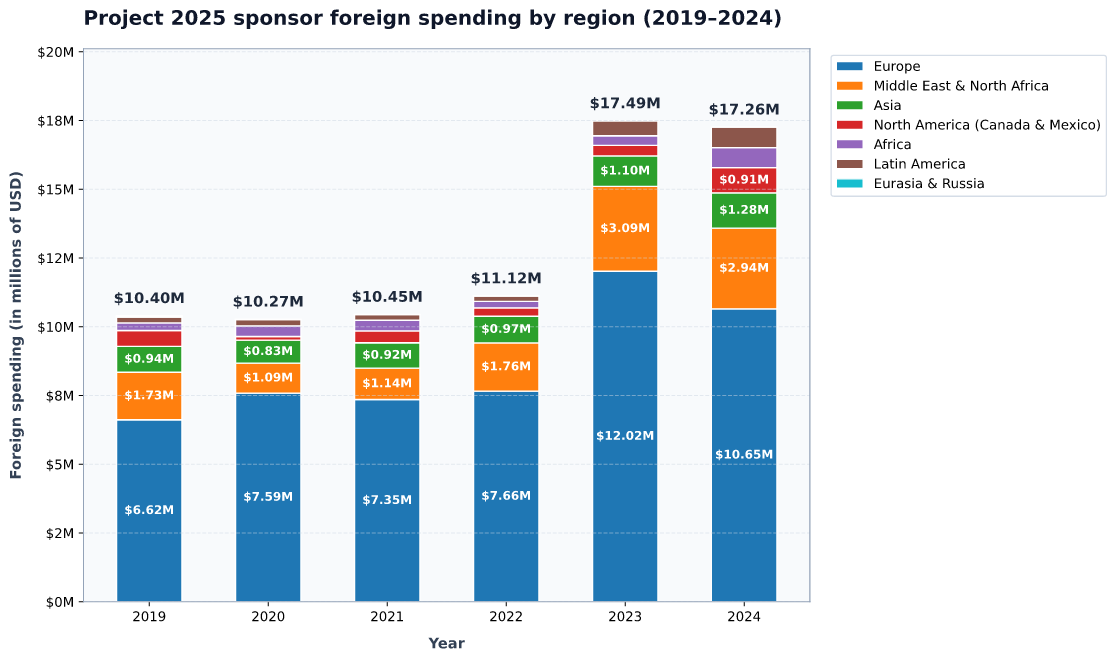
Paradoxically, the global influence of the Heritage Foundation, the main author and leader of Project 2025, is not reflected in the international spending it reports. It accounted for barely $1.2m of the $77m distributed by the 15 organisations over six years – of which $900,000 went to Europe, $23,000 to Latin America and $33,000 to Mexico and Canada.
Heritage’s overseas expenditure – a fraction of its more than $600m reported income between 2019 and 2024 – was earmarked for items such as ‘programme services’, ‘research, media and government relations’, and ‘education’.
Heritage also donates to other US organisations involved in opposing equal rights and spending abroad, such as ADF, which received $200,000 from Heritage between 2020 and 2022.
Heritage, ADF and ACLJ didn’t answer our requests for interviews.
Anti-abortion ‘consensus’
Much of Project 2025’s foreign policy aims to build international coalitions of conservative governments willing to embrace a shared vision of health, family and marriage.
According to the Global Project Against Hate and Extremism report, the “cornerstone” of this policy is the Geneva Consensus Declaration, a non-binding anti-abortion document signed in 2020, two weeks before Trump lost his first re-election bid. The declaration denies the existence of an international right to abortion and advocates for a single model of the family based on the marriage of a heterosexual couple.
“It’s a key Project 2025 effort because it is anti-LGBTQ and anti-women's rights. That's the vision these folks want in the world, not the International Declaration of Human Rights,” Heidi Beirich, an expert on extremism and a co-founder of the Global Project Against Hate and Extremism, told openDemocracy.
Gillian Kane, the director of global policy and research at international reproductive justice organisation Ipas, noted that the declaration is one way that the Trump administration is making clear its intention to reinforce its hemispheric hegemony across the Americas.
“All of this adds up to a precarious time for human rights, and particularly sexual and reproductive rights, in the region,” added Kane, who has been researching Project 2025 and the Geneva Consensus Declaration for some time.
Today, the declaration has 43 signatory countries, with Argentina and the Dominican Republic having joined in recent weeks.
“The Dominican Republic tracks, given the country’s terrible record on abortion access, though of course Argentina doesn’t track given it legalised abortion in 2020,” said Kane.
Argentine activist Fernando D’Elio said his country’s endorsement of the Geneva Consensus Declaration was very significant.
“For many years, Argentina played an important role in Latin America in promoting sexual and reproductive rights, same-sex marriage and gender identity on the international stage,” he said, adding that this was no longer the case.
But D’Elio, co-executive director of the organisation Akãhatã, which follows international human rights bodies, draws a distinction between foreign and domestic policy.
Progressive laws passed in Argentina since 2010, such as the legalisation of abortion and same-sex marriage and the right of an individual to change their gender identity on official documents, “were not just legislative changes”, he said, but “the result and driving force behind cultural transformations that have altered the way a significant section of Argentine society thinks about equality, families, sexuality, gender and personal autonomy”.
Milei’s government has not attempted to repeal these advances, although it did seek to amend the gender identity law to prohibit healthcare for transgender adolescents, by means of a decree that was suspended by the courts.
On abortion, D’Elio does not believe there will be any legal changes in the short term. The Milei government has not attempted to repeal legal abortion, and D’Elio does not believe it will do so in the short term. If that were to happen, he argued, “it would face very strong social and political resistance”. The strategy has instead been to financially strangle abortion services.
In 2024, before Trump had even begun his second term, openDemocracy documented how Milei was already implementing some of the most controversial policies of Project 2025, and how he had attempted to liaise with Heritage in 2023 through a foreign agent registered with the US Department of Justice.
Another country under pressure to sign the Geneva Consensus Declaration is Peru, which already has highly restrictive abortion laws. There, a broad coalition championing this agenda first came to the fore in 2016 with the ‘Don’t mess with my children’ campaign against the gender perspective in education, recalled activist George Hale, co-founder of Promsex, an organisation that promotes sexual and reproductive rights.
“Conservative religious organisations, political parties and members of Congress have been building a stable infrastructure for mobilisation, litigation, content production and legislative pressure,” Hale told openDemocracy. This movement “has become part of a broader offensive against democracy, the independence of institutions and civil society”.
Peru – like Paraguay and El Salvador – has laws designed to financially strangle and censor civil society organisations and independent media outlets. The aim, Hale said, is “to weaken the organisations that litigate, investigate, produce evidence and hold those in power to account”.
Democratic alliances
Hale and D’Elio think it is urgent to build broad democratic alliances that go beyond reacting to each individual right under attack.
For D’Elio, attacks are not “setbacks on gender issues”. “They are very clearly linked to the weakening of civic space, authoritarianism, attacks on multilateralism, economic precariousness and the erosion of democratic institutions,” he said. “If we treat them as an isolated culture war, we are accepting the framework proposed by the far right.”
Hale thinks there is a need to link equality and democracy, monitor foreign policy and continue investigating far-right networks. “We must identify who is funding these efforts, who is drafting the proposals, who is training parliamentarians, which organisations are acting as intermediaries, and how legislation models circulate between countries,” he said.
“We are up against a transnational infrastructure,” said Hale, “and we need to build an equivalent democratic infrastructure.”


